
Jewellery Design Details
Milgrain Jewellery: Specifying New Borders and Repairing Worn Detail
Milgrain, also written millegrain, is used to describe a fine beaded decorative edge or border. In a workshop brief, the name alone does not define the result. The position, scale and continuity of the detail should be shown on the actual piece or an approved design reference.
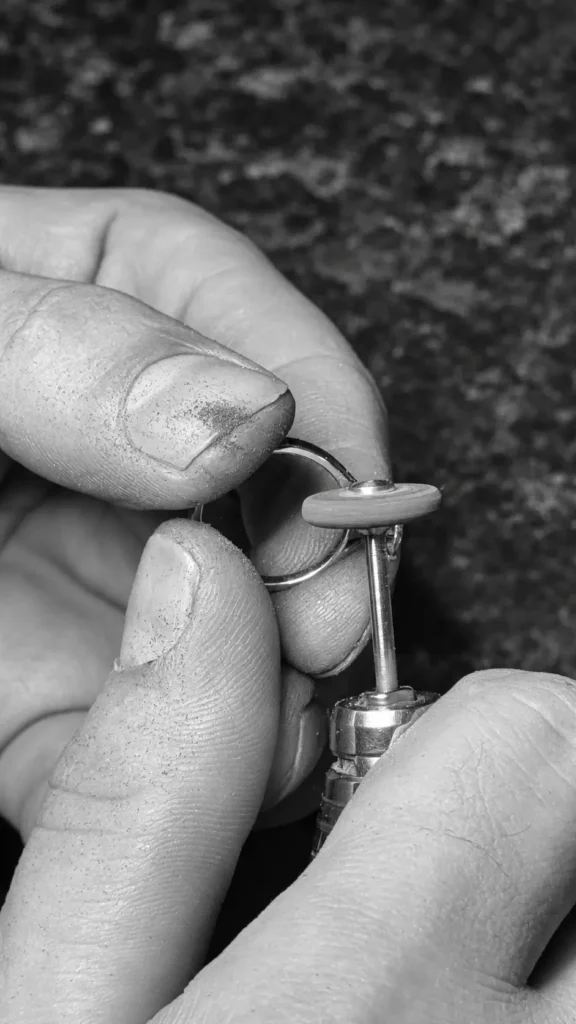
Milgrain, also written millegrain, is used to describe a fine beaded decorative edge or border. In a workshop brief, the name alone does not define the result. The position, scale and continuity of the detail should be shown on the actual piece or an approved design reference.
For a repair, the first question is what survives. A worn border, a locally damaged section and a new border requested on a plain surface are different jobs. They should not be combined into a general polishing instruction without an assessment and a clear approval.
Discuss milgrain jewellery repair
Mark the border to be assessed and provide close photographs that show its scale and surrounding condition.
Identify the decorative feature precisely
Use a close view to mark the line or edge under discussion. Distinguish the decorative border from beads that form part of a stone setting. If stones sit nearby, include their relationship to the detail so the workshop can consider the surrounding construction.
The pavé production guide discusses a setting layout rather than a decorative border alone. Keeping those descriptions separate helps avoid a brief in which a request about appearance is mistaken for authority to alter metal involved in holding stones.
Define the reference for a new border
Show where the border should begin and end, how it should follow corners and whether it continues around the whole piece. Use a suitably clear reference for the desired scale. A magnified image can make a fine detail look much heavier than intended, so include the actual dimensions of the component.
Ask the workshop to confirm what can be achieved on the proposed surface. A&M’s repairs and alterations page includes millegrain and cutting-line work within its assessed scope. That still requires an item-specific proposal; it is not a promise that every reference can be reproduced on every construction.
Assess worn detail before promising a match
For an existing piece, record the best-preserved section and the area needing attention. Consider whether the customer wants a local improvement or a more continuous renewed appearance. The workshop should explain how the condition of the surrounding metal affects the options.
Do not promise an invisible match from a photograph. The original detail may vary around the piece, and a newly worked section may need to be considered against adjacent wear. Agree the intended level of consistency rather than assuming that all evidence of age should disappear.
Before you approve the work
Agree whether the aim is to retain, repair or recreate the border before broader refinishing begins.
Coordinate the surrounding finish
Specify the finish on each side of the border and identify details that should remain intact. The contrasting finishes guide is useful where polished, satin or recessed surfaces meet. A border should be reviewed together with those transitions.
If broader polishing is proposed, agree its limits before the decorative work is finalised. The preserving detail guide explains why edges and small features need deliberate protection in the brief. Separate an authorised surface improvement from a request to change the design.
Approve the border as part of the whole piece
At completion, review the line, continuity and relationship to the surrounding finish. Check the accepted repair scope as well as appearance: a local repair and a complete border renewal should have different records. Any separate stone-setting work should also remain identifiable.
A useful milgrain brief shows the exact feature and the result being sought. Clear references and an early condition assessment allow the retailer to discuss a realistic repair or new detail without treating a decorative technique as a universal restoration solution.
Plan the next step with A&M
Identify the beaded border, surrounding finish and best-preserved reference before agreeing a new or repaired milgrain detail.
Frequently asked questions
Are milgrain and millegrain different instructions?
Both spellings are used for the fine beaded decorative detail. A visual reference is still needed to define the specific border intended.
Is a milgrain border the same as the beads in a pavé setting?
The brief should distinguish decorative edging from metal involved in holding stones. Mark the exact feature being discussed.
Can a worn border always be restored to its original appearance?
That cannot be assumed. The surviving detail and surrounding metal need assessment before a repair proposal or matching expectation is agreed.