
Stone Setting & Product Construction
Planning Pavé Jewellery: Stone Matching, Layout and Setting Access
Pavé jewellery brings a repeated arrangement of small stones into close visual relationship. That makes consistency in layout, matching and workmanship especially important to the finished appearance. The production plan should establish those relationships before the wider quantity is released.
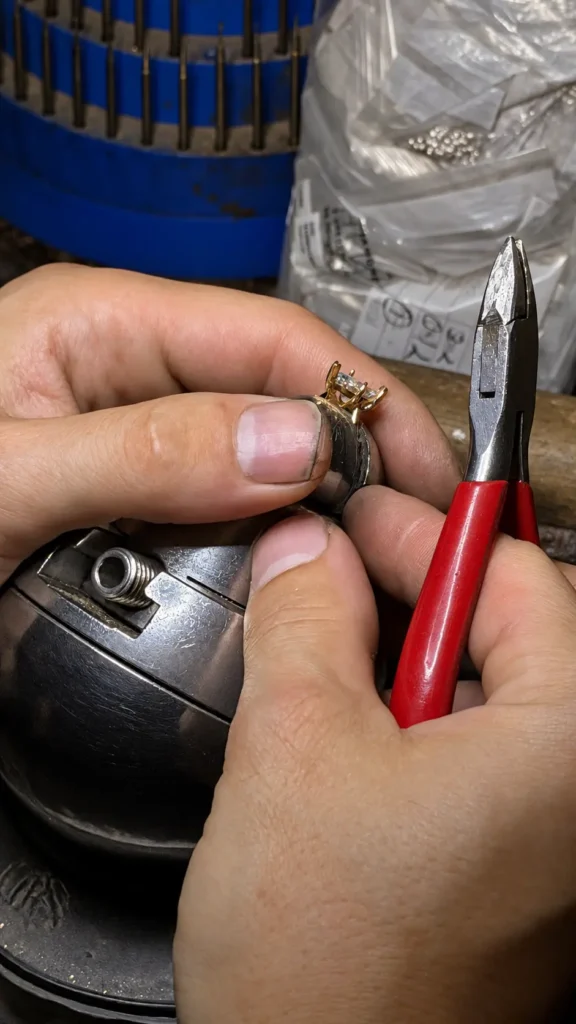
Pavé jewellery brings a repeated arrangement of small stones into close visual relationship. That makes consistency in layout, matching and workmanship especially important to the finished appearance. The production plan should establish those relationships before the wider quantity is released.
Begin with the intended pattern and the actual stone requirement. A render can communicate the effect, but the workshop needs more precise information to assess the mount, setting access and the handling of variations.
Discuss pavé jewellery production
Bring the pavé layout, stone specification and proposed component geometry.
Define the layout clearly
Show where the pavé begins and ends, how it relates to edges and other features, and whether the arrangement changes across variants. Keep the stone count and positions connected to the current design.
If the design changes size, review the pattern rather than assuming it can be stretched unchanged. The setter should assess the actual geometry and the remaining material for the intended construction.
Specify the stones beyond total weight
Record material, shape, dimensions and the matching requirement. Total carat weight does not establish the fit of individual stones or the visual consistency of a close arrangement. Clarify what variation is acceptable for the design.
Keep any matched groups or position assignments intact. If a stone is replaced, the substitution should meet both the dimensional and visual requirements. A spare from the same parcel should not automatically be assumed suitable for every position.
Resolve access before assembly
Discuss how the setter will reach the relevant areas and which neighbouring components or decorative details could affect the operation. Preparation may need to occur before later assembly restricts access.
Known gemstone treatments and condition should also be disclosed. GIA’s durability guidance provides background on why gemstone identity matters to workshop procedures. The actual setting and cleaning route should be assessed by the relevant specialist.
Before the next production step
Approve a representative layout before setting the wider quantity.
Approve a representative section or piece
Choose a sample that shows the important pattern, edge relationships and finished appearance. A simplified sample may not establish the result around a curved or interrupted section. Record what the approval covers.
Assess the arrangement as a whole and the individual workmanship where appropriate. GIA’s quality benchmarks support checking defined features; they should not be presented as certification of a particular sample or supplier.
Plan inspection and exceptions
For repeated work, identify the reference used for matching and layout. Keep pieces requiring review separate from the accepted batch, and record any stone replacement or approved change to the pattern.
Discuss stone setting with A&M using the model, stone information and intended finish together. Confirm whether the mounts arrive prepared for setting and which additional operations form part of the quotation.
Establish the pattern before repeating it
Pavé production needs a clear relationship between the design, stones and prepared mount. Define that relationship in the sample and records, then use it to assess the rest of the run consistently.
Plan the work with A&M
A&M can assess your trade enquiry in the context of the actual piece and requested workshop stages. Bring the references discussed in this guide so the next decision can be made on clear information.
Frequently asked questions
Can total carat weight specify the pavé stones?
It is useful commercial information, but it does not replace individual dimensions, quantity and matching requirements. The setting plan needs the details relevant to fit and layout.
Does one flat sample approve every curved pavé design?
Not automatically. The representative sample should show the features that matter to the actual piece, including changes in geometry or access that affect the layout.
What happens if a stone in the parcel does not match?
Keep it identifiable and obtain the agreed replacement or reallocation decision. Do not use it solely to complete the count if it falls outside the accepted requirement.