
Production & CAD
What to Include in a Jewellery Manufacturing Brief
A practical checklist for commissioning a one-off piece, prototype or repeat batch, covering materials, measurements, stones, finish and approval stages.
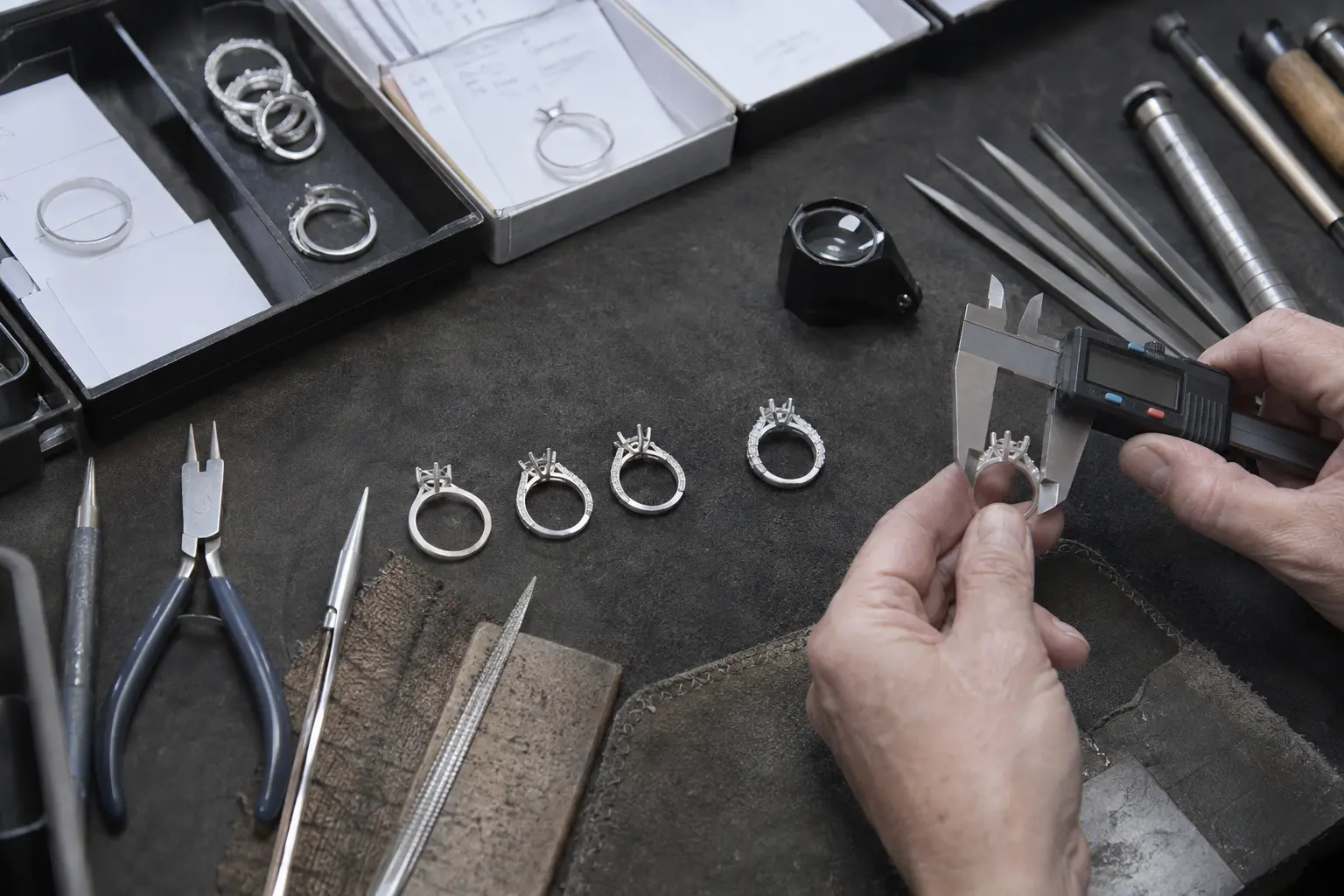
A jewellery manufacturing brief should let the workshop understand what is being made, what is being supplied and what must be approved before work continues. A sketch or reference image can start the conversation, but it rarely answers every production question. Metal specification, finished measurements, stone information, surface finish, quantity and responsibility for later stages all affect how a job is assessed.
For trade clients, a clear brief is not paperwork for its own sake. It creates a shared record for quoting, scheduling and checking. It also makes it easier to identify decisions that still need to be made before metal, stones or bench time are committed. This guide covers the complete manufacturing instruction for a one-off piece, prototype or repeat batch. For incoming repairs, use our workshop job preparation guide; for the design file itself, see our CAD brief checklist.
Preparing work for the bench?
Send A&M a clear outline of the piece, materials, quantity and required stages so the workshop can assess the job on its actual requirements.
Start with a job identity that stays with the piece
Give the job a reference that appears on the brief, drawings, stone list, packaging and subsequent messages. This might be your own stock code, order number or collection reference. The important point is consistency. Product names such as “oval halo ring” are useful descriptions, but they may not be unique when several similar pieces are moving through production.
State whether the work is a new one-off piece, a prototype, a repair, a sample for approval or a repeat of an existing item. If it repeats an earlier job, identify the approved version and describe every requested change. Do not rely on “same as last time” when the metal, size, stones or finish differ.
Define the scope before describing the appearance
List the stages you want the workshop to complete. Manufacturing, assembly, setting, polishing, rhodium finishing, engraving, sizing and repair are separate operations, even when several form part of one order. Confirm which components you will supply and which you expect the workshop to source or produce.
For an existing piece, distinguish between the reported problem and the authorised work. A customer may report that a ring catches on clothing, for example, but that observation does not by itself specify whether the required work is inspection, retipping, rebuilding, resetting or another repair. The workshop needs permission boundaries as well as a description of the concern.
Specify the metal in full
Record the metal, fineness and colour for the complete piece and for any component that differs. “White metal” is not a manufacturing specification. Platinum, white gold and silver have different working and finishing considerations, while two-tone work needs each section identified clearly.
Include the current item weight when relevant, but do not treat weight alone as a finished specification. Finished dimensions, wall thicknesses, profile and construction determine how the piece is made and how it feels. If the workshop is expected to work to a target weight, explain whether that figure is a design target, a cost-control limit or a required finished range.
Confirmed UK requirement: Precious-metal articles supplied in the UK may need an approved hallmark, subject to the applicable metal and weight rules. The British Hallmarking Council’s official business guidance on hallmarking explains the legal framework and dealer responsibilities.
Practical workshop point: The brief should say who is arranging hallmarking and at what stage. This is process guidance, not legal advice for a particular article.
Use measurements, not only reference images
Supply scale drawings, CAD files or dimensioned sketches where they exist. Record the measurements that control fit and appearance, such as ring size, band width and depth, setting height, pendant dimensions, chain length, post position or bangle opening. Identify which measurements are fixed and which can move within an agreed tolerance.
A photograph can show proportion and visual intent, but perspective can distort size. Place any reference image beside written dimensions and label whether it is a design instruction, a general style reference or an image of the exact article. If an existing piece must be matched, say whether the match concerns profile, dimensions, finish, stone layout or all four.
Give the workshop complete stone information
For supplied stones, list the quantity, material, shape and measurements in millimetres. Add report numbers where applicable, but keep a direct stone-to-position reference when several stones are involved. Carat weight does not replace physical dimensions for setting work.
GIA’s guide to reading a diamond grading report confirms that report measurements are recorded as minimum diameter by maximum diameter by depth for round diamonds, and length by width by depth for fancy shapes. Those measurements help identify the stone and inform the setting, but the physical stone should still be inspected before the final seat is cut. See the GIA diamond grading report guide.
Disclose known treatments, existing chips, abrasions, surface-reaching features or previous repair work. Different gem materials and treatments can respond differently to heat, chemicals and cleaning. GIA’s professional discussion of gemstone durability in design and repair explains why the identity and condition of a stone matter to setting, repair and cleaning decisions.
Describe the finish so it can be checked
Terms such as “high polish”, “satin”, “brushed” and “rhodium plated” are more useful when the brief also identifies where the finish begins and ends. Mark contrasting areas on a drawing. For two-tone or mixed-finish work, label each surface rather than relying on colour alone.
State which marks, engravings or surface details must be preserved. On repair and refinishing work, note any area that should not be polished or altered. If a finish sample has already been approved, reference the sample or provide a clear image made under neutral lighting.
Set tolerances and approval points before production
A tolerance defines acceptable variation around a specified measurement or result. It should be agreed for features that materially affect fit, assembly or consistency. Avoid applying a single generic tolerance to every part of a piece. A ring size, stone seat, cast texture and overall length do not necessarily require the same control.
For repeat production, decide whether the first completed item must be approved before the remaining quantity proceeds. A first-off review can check proportion, fit, setting layout, assembly and finish against the agreed brief. Record who can approve it and how approval will be documented.
Planning a prototype or repeat batch?
Share the approved reference, required quantity, tolerances and first-off approval point before production is scheduled.
State quantity, delivery requirement and dependencies
Give the total quantity and any breakdown by size, metal, stone or finish. If components arrive in stages, explain the sequence and identify any item that the workshop must receive before assessment or production can begin.
Provide the date the completed work is required, together with any genuine event, launch or onward delivery dependency. A requested date is not the same as a confirmed workshop completion date. Timing can only be agreed after the scope, materials, condition and current schedule have been assessed.
For postal work, agree the job and return arrangements before dispatch through Workshop by Post. Package pieces separately where contact could cause damage, identify every enclosed item and retain your own record of the contents. Do not place loose stones or unlabelled components in a parcel.
What to attach to the brief
- A unique job reference and your contact details.
- A concise scope of authorised work.
- Dimensioned drawings, CAD files or clearly labelled sketches.
- Metal, fineness, colour and component information.
- A stone schedule with quantity, identity, shape and millimetre measurements.
- Finish instructions, including areas and details that must be preserved.
- Quantity, size or variation breakdowns.
- Critical tolerances and approval stages.
- Hallmarking, engraving, packaging and return requirements.
- The requested delivery date and any known dependency.
- Images of the exact item, with confidential customer information removed where it is not needed.
Review the brief as a controlled record
Keep one current version and date it. When a specification changes, record the change in writing and make clear which earlier instruction it replaces. Scattered amendments across calls, messages and image annotations can leave the workshop without one reliable source of truth.
The brief does not replace inspection. Existing jewellery may reveal worn joints, loose stones, old repairs or material differences that were not visible in photographs. New production may also require technical adjustment after CAD, prototyping or a first-off review. The purpose of the brief is to make those decisions controlled and traceable, not to suggest that every variable can be resolved before the piece reaches the bench.
A better brief supports a better production conversation
The most useful jewellery manufacturing brief is specific enough to quote and check, while leaving room for the workshop to raise technical questions. Identify the piece, define the authorised stages, describe the materials and stones, supply controlled measurements, set approval points and state the delivery requirement. Where information is unknown, mark it as a decision to be made rather than filling the gap with an assumption.
Have a brief ready for review?
A&M provides manufacturing and production support for one-off work, prototypes and repeat batches for verified trade clients from its Hatton Garden workshop.
Frequently asked questions
What is a jewellery manufacturing brief?
It is the controlled job record used to describe the item, required work, materials, dimensions, stones, finish, quantity, approvals and delivery requirement. Its exact format can vary, but the information should be clear enough for the workshop to assess and discuss the job.
Is a photograph enough for a jewellery manufacturing quote?
Usually not. A photograph may show the design or condition, but it may not confirm scale, metal, stone dimensions, construction, hidden wear or the full scope. The workshop may need the physical item, measurements, drawings or further information before confirming a quote.
Should I include carat weight or stone measurements?
Include both when they are available. Carat describes weight. Millimetre measurements describe the physical dimensions that affect the setting and layout. For supplied stones, use a stone schedule that connects each stone with its intended position.
What should a repeat-production brief include?
Reference the approved sample or version, list the quantity and variants, record any changes, define critical tolerances and state whether first-off approval is required before the balance proceeds.
Does a complete brief guarantee a delivery date?
No. A requested date still needs to be assessed against the job, materials, item condition, dependencies and workshop schedule. Treat timing as confirmed only when the workshop has agreed it.
Related reading
Explore the related stages of preparing work for the workshop: