
Finishing & Quality Control
Preserving Edges and Fine Detail During Jewellery Polishing
Polishing should produce the agreed surface while preserving the features that define the jewellery. A bright finish can still be wrong if an edge has become rounded or a fine detail has lost its intended character. Those features need to be identified before work begins.
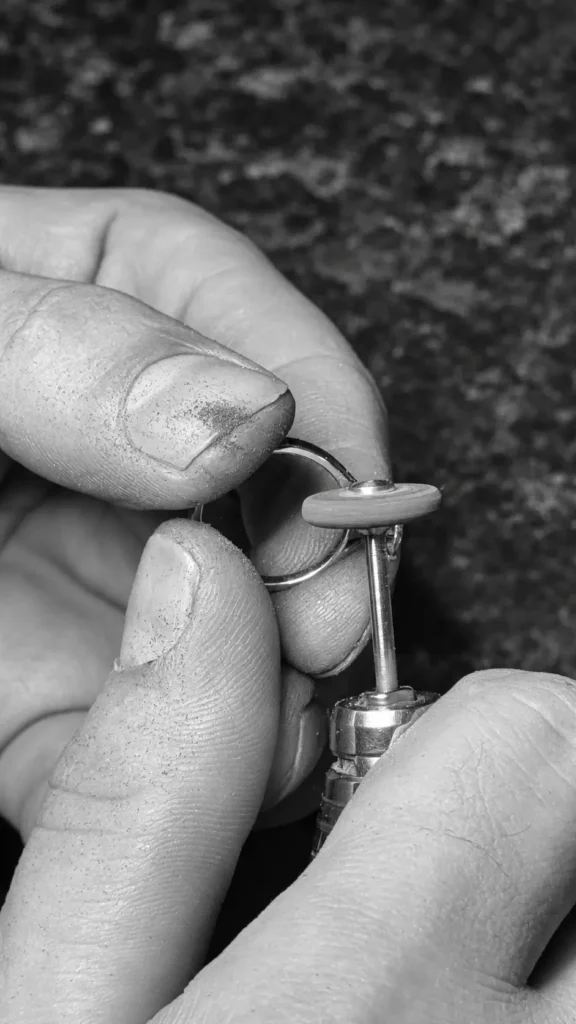
Polishing should produce the agreed surface while preserving the features that define the jewellery. A bright finish can still be wrong if an edge has become rounded or a fine detail has lost its intended character. Those features need to be identified before work begins.
The starting condition matters. Preserving a crisp detail on a new component is a different task from improving a worn or damaged surface. The brief should describe which result is expected and which compromises require approval.
Discuss preserve jewellery detail polishing
Mark the edges, engraving and details that define the design before polishing.
Identify the design’s defining features
Mark ridges, corners, engraving, texture boundaries and other details that should remain. Use clear photographs or a physical reference where words are insufficient. Explain whether the feature is decorative, functional or both.
Do not rely on the polisher to infer importance from visual prominence. A small edge near a setting or a discreet mark can matter to the product even if it is not obvious in the main photograph.
Establish the starting condition
Record existing wear, damage or earlier finishing. If a detail is already softened, state whether the request is to preserve its current condition or assess possible restoration. Those are different scopes of work.
For new production, compare the component with the approved reference before finishing. A weak detail in the incoming part should not automatically be treated as something final polishing will correct.
Separate surface improvement from reshaping
Discuss any defect that may require significant material removal or alteration of the profile. The workshop should assess whether the requested surface can be achieved while retaining the intended geometry.
GIA’s prefinishing and polishing material provides reference information on evaluating defined finishing stages. The client should agree the desired result, while the workshop selects a suitable route for the actual piece.
Before the next production step
Separate a surface improvement from any proposed change to the profile.
Define finish boundaries clearly
If adjacent areas have different finishes, show where each begins and ends. A narrow polished edge beside a textured field needs a more precise instruction than a general request for mixed finishes.
Identify any areas that must remain untouched for later setting, joining or marking. A&M’s jewellery polishing service should be discussed alongside those protected features and the production stages still to come.
Inspect detail as well as reflection
Assess the finished surface and the retained shape separately. Use consistent viewing conditions and compare the important edges or details with the approved reference. A highly reflective photograph alone may make a change difficult to judge.
If the result differs, describe the specific feature rather than simply asking for more polish. Additional finishing may not be the right correction. Agree the next action before further work changes the evidence or remaining geometry.
Put preservation into the brief
A precise polishing instruction names both the surface to achieve and the details to retain. That gives the workshop a clearer acceptance standard than brightness alone and helps preserve the identity of the design.
Plan the work with A&M
A&M can assess your trade enquiry in the context of the actual piece and requested workshop stages. Bring the references discussed in this guide so the next decision can be made on clear information.
Frequently asked questions
Can polishing sharpen a worn edge?
Do not assume it can. A worn profile needs assessment, and restoring its form may involve work beyond routine polishing. Agree the achievable result before proceeding.
Should hallmarks or engraving be mentioned?
Yes, identify marks and details that must be preserved. Their location and condition should be considered when the finishing scope is agreed.
How can I approve a finish without losing fine detail?
Use a representative sample and assess the protected features separately from the overall shine. Record both aspects of the approved result for the wider run.