
Finishing & Quality Control
How to Maintain a Consistent Polish Across a Jewellery Batch
A consistent polish across a jewellery batch begins before the first piece reaches final finishing. The incoming components, preparation standard and approved reference all influence whether repeated work produces a coherent result. The same finish name on every job sheet is not enough on its own.
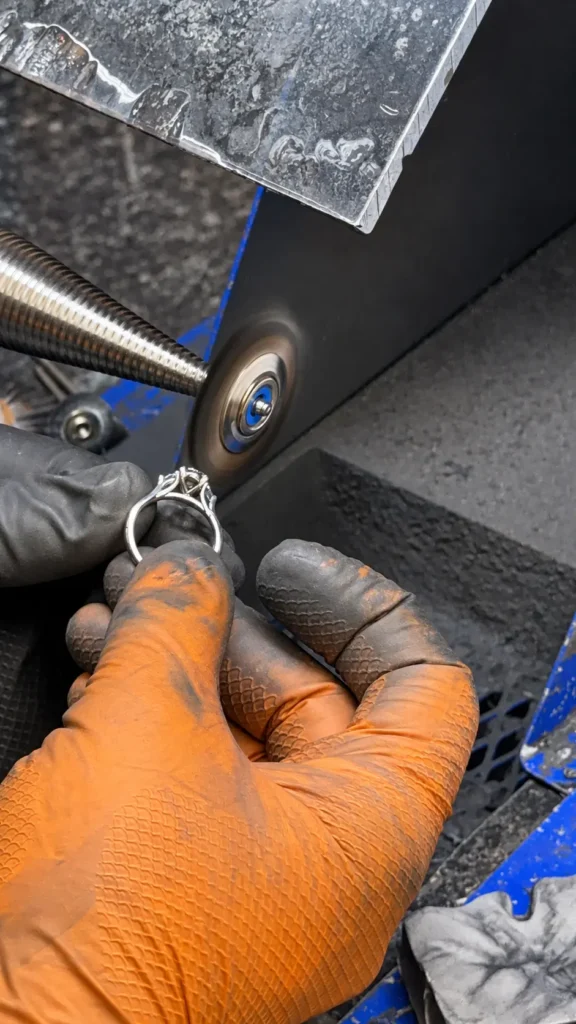
A consistent polish across a jewellery batch begins before the first piece reaches final finishing. The incoming components, preparation standard and approved reference all influence whether repeated work produces a coherent result. The same finish name on every job sheet is not enough on its own.
Start by defining which pieces are intended to match. A mixed order with different metals, textures or component conditions should not be treated as one uniform finishing run merely because it arrived together.
Discuss consistent jewellery batch polishing
Bring the approved finish reference and describe the incoming batch condition.
Establish an approved reference
Use a sample that represents the actual material, geometry and finished condition. Identify the relevant surfaces and any details that must remain. Keep the approval record clear about what the sample establishes.
If no physical sample is available, agree the best alternative with the workshop and identify its limits. Photographs taken under inconsistent lighting can make comparison difficult, particularly on reflective surfaces.
Check the preparation entering the run
Different surface conditions can require different work before the final polish. Separate parts that need correction from those ready for the agreed finishing stage. Otherwise, variation in preparation can become variation in the finished result.
A&M’s production guidance notes that component consistency affects the route. Give the workshop accurate information about supplied batches rather than assuming a repeated design means identical incoming condition.
Keep genuine variants distinct
Group pieces by the specification that matters to finishing, such as material, texture or protected detail. Record intentional differences so an inspector does not try to make unlike variants appear identical.
Maintain references during handovers between operations. If the same trays or labels are used for several jobs, check that a component cannot lose its identity when it moves to finishing or final inspection.
Before the next production step
Resolve variable incoming surfaces before treating the run as uniform.
Review during production
Agree appropriate review points instead of leaving every comparison until the whole batch is complete. An early check can establish whether the incoming condition and planned route are producing the approved result.
GIA’s finishing benchmarks illustrate the value of evaluating defined workmanship stages. The particular checks and frequency should be selected for the actual order, not copied as an unverified universal sampling rule.
Compare the finished pieces consistently
Assess the relevant surfaces under suitable, consistent viewing conditions. Compare with the approved sample and, where useful, across the batch. Include edges and protected detail rather than judging only the brightness of broad surfaces.
Keep held pieces separate and record the reason. If a finishing variation is accepted for a particular item, document the decision without silently redefining the standard for the remaining run or next order.
Repeat a standard, not just an instruction
Consistent finishing depends on controlled inputs and an agreed reference that survives each handover. Establish those conditions, then use inspection to confirm the result rather than relying on quantity or repeated terminology.
Plan the work with A&M
A&M can assess your trade enquiry in the context of the actual piece and requested workshop stages. Bring the references discussed in this guide so the next decision can be made on clear information.
Frequently asked questions
Does using the same finish name guarantee a match?
No. The material, preparation and interpretation of the finish can differ. A representative approved reference makes the expected result clearer.
Should mixed metals be checked as one batch?
Keep their specifications distinct. They may share some visual requirements, but the intended result should be assessed for each actual material and variant.
Is checking the first piece enough?
The first piece helps establish the result, but the rest of the batch still needs the agreed inspection arrangements. It does not prove that later inputs or workmanship remain consistent.