
Jewellery Design Details
Fitted Wedding Bands: Designing Around an Existing Engagement Ring
A fitted wedding band begins with the ring it must sit beside. Its curve or contour should respond to the actual engagement ring, including the setting, shoulders and underside. A photograph of a similar style can communicate an idea, but it cannot establish the precise relationship between the two finished pieces.
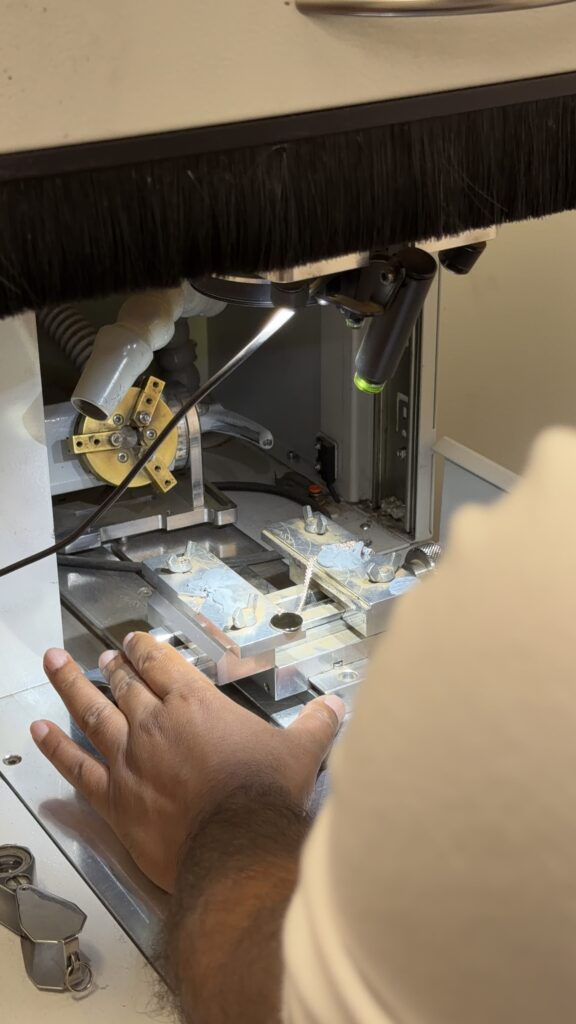
A fitted wedding band begins with the ring it must sit beside. Its curve or contour should respond to the actual engagement ring, including the setting, shoulders and underside. A photograph of a similar style can communicate an idea, but it cannot establish the precise relationship between the two finished pieces.
The first design decision is also a personal one: how closely should the band follow the existing ring? Some customers want a close visual fit, while others prefer a deliberate space or a band that also looks balanced when worn alone. Record those priorities before the contour is drawn.
Discuss fitted wedding band design
Provide the engagement ring and explain whether the band should follow its shape closely or leave a deliberate gap.
Use the existing ring as the main reference
Where practical, arrange assessment of the actual engagement ring. Record its dimensions, setting profile and intended orientation on the finger. If it has been altered since purchase, the original product specification may no longer describe every relevant feature.
A&M’s CAD and 3D scanning page explains that scan data records accessible geometry and may require further interpretation. A scan can support the design process, but it should not be treated as automatic proof that a fitted band has all the necessary clearances.
Define contact and clearance deliberately
Ask where the rings may meet and which areas should remain separated. Consider the setting, shoulders and any stones on the sides, not only the outlines seen from above. The workshop needs to assess the relationship in the normal wearing position.
Avoid asking for no gap anywhere without discussing the practical consequences. A visually close fit and a suitable construction need to be considered together. If the customer’s preferred arrangement requires a compromise, use a drawing or model to explain it before manufacture.
Decide how the band should work on its own
A contour that follows an engagement ring closely may look different when worn alone. Ask whether independent wear is part of the brief. That can influence the overall shape, decorative balance and the way the band is presented to the customer for approval.
The wedding ring specification guide remains relevant for size, width, profile and finish. A fitted contour adds to those requirements; it does not replace them. Keep the complete band specification connected to the reference engagement ring.
Before you approve the work
Approve the relationship between both rings before the fitted band is released for manufacture.
Use a prototype to answer a defined question
Where a physical sample is appropriate, decide what it needs to demonstrate: the contour, visual spacing, orientation or relationship to the setting. The prototyping guide explains why a sample should have a clear purpose and known limitations.
Do not treat a prototype in a different material as proof of every characteristic of the finished precious-metal band. Record what has been approved and which construction or finishing details still need confirmation. If the engagement ring changes, revisit the fitted reference before continuing.
Approve the pair as an arrangement
The final approval should show both rings together and identify the accepted gap, orientation and finish relationship. Record whether the engagement ring itself is to remain unaltered. Supplying it as a reference should not be interpreted as permission to modify its setting or shoulders.
A fitted band is most successful when the customer’s wearing preference and the existing ring’s geometry are resolved together. That creates a clear brief for a deliberate pair, rather than a new band based on an approximate outline.
A personal jewellery enquiry?
Choosing a wedding band to accompany your engagement ring? Contact Kinzy London about a personal purchase or design enquiry and confirm the available options. A&M’s workshop services are for jewellery businesses.
Frequently asked questions
Is a photograph enough to make a precisely fitted band?
It can begin the design conversation, but accurate fitting may require physical measurements, scan information or assessment of the actual engagement ring.
Must a fitted band touch the engagement ring everywhere?
No. The desired contact and clearance should be agreed according to the design and assessed construction, not a universal no-gap rule.
Can the band also be designed to wear alone?
Yes, that can be included as a design objective. Explain it early because it may affect the contour and visual balance of the band.