
Finishing & Quality Control
Pre-Polishing Before Stone Setting: When and Why It Matters
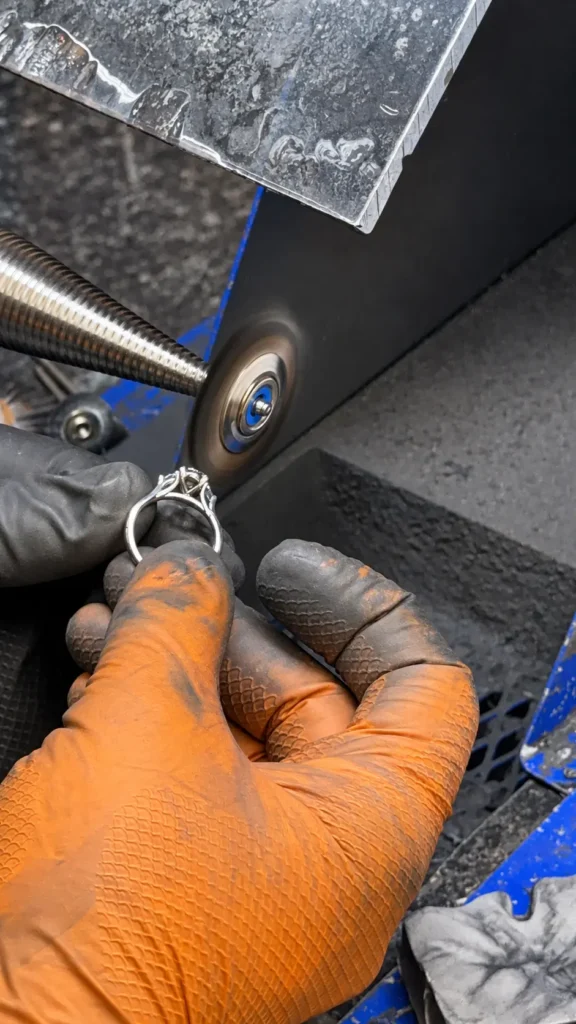
Pre-polishing before stone setting is a question of access and production sequence. Some surfaces become harder to reach once stones are installed, while other areas still need work from the setter. The route should therefore be agreed for the mount and stone arrangement rather than treated as one fixed rule for every piece.
Pre-polishing before stone setting is a question of access and production sequence. Some surfaces become harder to reach once stones are installed, while other areas still need work from the setter. The route should therefore be agreed for the mount and stone arrangement rather than treated as one fixed rule for every piece.
The commissioning brief should identify the expected appearance and the stage at which the mount is handed to the setter. It should also make clear what finishing remains afterwards.
Discuss pre polishing before stone setting
Discuss which mount surfaces need attention before the stones restrict access.
Identify surfaces that become less accessible
Review the inside of settings, recesses and areas close to the planned stone position. Decide which need preparation before access is restricted. A render may show a bright interior without explaining how that finish will be achieved physically.
GIA’s platinum finishing reference includes consideration of surfaces inside settings. Use such material as background for discussing the actual mount, rather than transferring a complete process unchanged to a different alloy or construction.
Preserve the setter’s working requirements
Ask the setter which areas must remain available for preparation and securing the stone. Pre-polishing should support the next operation, not remove or reshape material that operation depends on.
Keep dimensions and design details in view during the discussion. A general request for the mount to be completely finished can be misleading if it does not identify what remains to be cut, adjusted or joined.
Coordinate the handover between specialists
Define the condition in which the setter expects to receive the mount. If polishing and setting are handled by different people, record the agreed boundary between their work. Each should understand which surfaces have been treated and what still remains.
A&M’s mount preparation and stone setting services can be discussed together when agreeing the route. Confirm the specific operations included for the commission.
Before the next production step
Confirm the setter’s required starting condition before pre-polishing is completed.
Keep stone information with the job
Known material, treatment and condition information should remain available when deciding later cleaning and finishing. GIA’s gemstone durability guidance explains why workshop procedures need to consider the gemstone involved.
Do not assume that every method suitable for an empty mount remains suitable after setting. The complete piece should be assessed in its actual state before subsequent work is carried out.
Plan the final finish check
Pre-polishing does not necessarily mean no finishing will be required after setting. Agree the remaining work and inspect the completed piece against the intended result. Include the surfaces whose access was the reason for early preparation.
If later work changes an approved detail or reveals a surface issue, record it and obtain the appropriate assessment. Avoid repeatedly passing the piece between operations without a clear description of the concern.
Agree the sequence around access
The benefit of pre-polishing comes from doing appropriate work while the relevant surfaces are accessible. Define that work with the setter and finisher, then preserve the handover record through to final inspection.
Plan the work with A&M
A&M can assess your trade enquiry in the context of the actual piece and requested workshop stages. Bring the references discussed in this guide so the next decision can be made on clear information.
Frequently asked questions
Should every surface be fully polished before setting?
Not necessarily. The setter may still need to work particular areas. Agree which surfaces are prepared early and which remain for later operations.
Does pre-polishing replace final polishing?
It may reduce later access difficulties, but the completed piece can still need an agreed finishing stage. Specify both endpoints rather than assuming one automatically replaces the other.
Can a mount be cleaned the same way before and after setting?
Do not assume so. The presence and condition of stones can change which procedures are suitable. The workshop should assess the complete piece before later cleaning.