
Finishing & Quality Control
Jewellery Surface Preparation: What Happens Before Final Polishing?
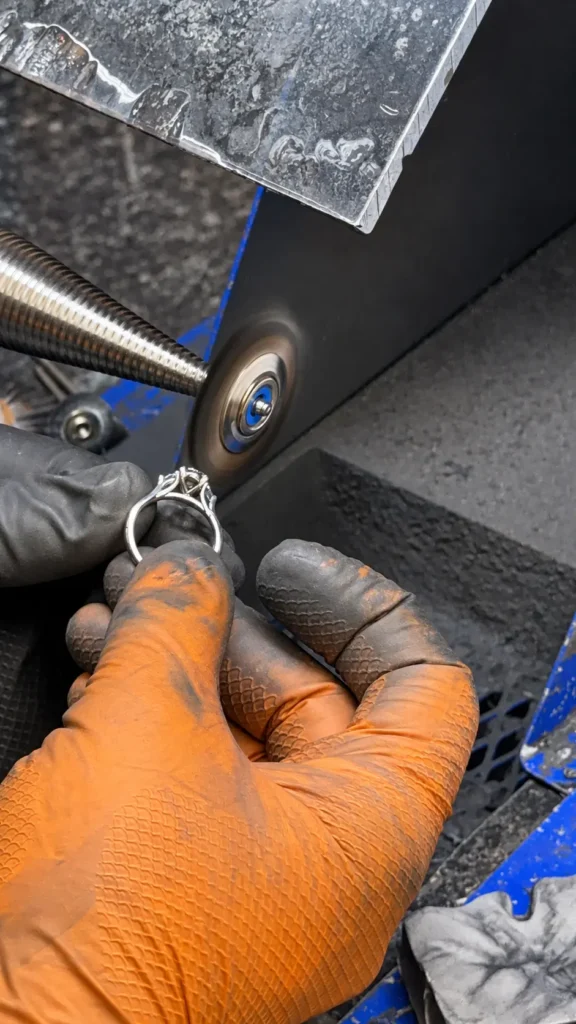
Jewellery surface preparation establishes the condition from which final polishing can produce the agreed appearance. It is not simply a less glossy version of the same operation. The workshop needs to assess marks, surface defects and the geometry that must remain before deciding how the piece should progress.
Jewellery surface preparation establishes the condition from which final polishing can produce the agreed appearance. It is not simply a less glossy version of the same operation. The workshop needs to assess marks, surface defects and the geometry that must remain before deciding how the piece should progress.
For the commissioning client, the useful instruction is the required result and the features to preserve. The appropriate tools and working sequence should be selected for the actual material and construction.
Discuss jewellery surface preparation
Identify the starting surface and the features that must survive preparation.
Assess the starting surface
Identify whether the piece is a casting, an assembled mount or an item that has already undergone other work. The starting condition affects the preparation requirement. A repeat order should not be assumed identical if its components arrive in a different state.
Record visible defects before further work. A scratch, a pit and a distorted edge are different observations and may need different responses. Describe the location and appearance rather than using one broad request to polish everything away.
Separate correction from routine preparation
Some surface work belongs within the agreed preparation scope; other issues may require a new assessment. Ask the workshop to explain when a defect would affect dimensions, construction or the feasibility of the requested finish.
Do not assume that removing more material will always improve the result. A proposed correction needs to preserve the important design features. If it cannot, the component may need another route or replacement.
Define what must remain unchanged
Identify crisp edges, fine texture, engraving and other details that are part of the approved design. Mark any surfaces that must remain suitable for setting or joining. These instructions help connect preparation with the production stage that follows.
A&M’s mount preparation service makes that next stage central to the scope. State whether the piece is being prepared for assembly, setting, inspection or final finishing.
Before the next production step
Obtain a decision on deeper defects before further material is removed.
Understand the role of final polishing
Final polishing depends on the surface and shape presented to it. GIA’s prefinishing and polishing benchmarks distinguish related stages when assessing platinum workmanship. The appropriate sequence for a particular piece should be agreed with its workshop.
As the client, specify the finish on the relevant surfaces and provide a reference where necessary. A broad phrase such as high polish should not conceal an expectation that every recess or protected detail will be treated identically.
Inspect at the agreed handover point
The preparation stage should end in a condition the next specialist can use. Confirm that the agreed areas are ready and that protected features remain intact. Record any unresolved concern instead of passing it forward without explanation.
Where the piece contains stones, the cleaning and handling route must suit them. Known treatments or condition issues should remain visible in the job record so a surface-preparation instruction does not override material-specific considerations.
Treat preparation as an accepted stage
A clear preparation brief establishes the starting condition, protected details and required endpoint. That allows final polishing to work towards the approved appearance without being expected to resolve every earlier production issue.
Plan the work with A&M
A&M can assess your trade enquiry in the context of the actual piece and requested workshop stages. Bring the references discussed in this guide so the next decision can be made on clear information.
Frequently asked questions
Can final polishing remove every visible defect?
No. The defect and remaining material need assessment. Some issues require a different correction or replacement, and polishing alone should not be assumed to restore the intended geometry.
Is a prepared mount ready for retail presentation?
Not necessarily. It may be ready for assembly or setting, with later finishing still required. Confirm the precise condition and next stage in the scope.
Should I specify a polishing compound in the brief?
Usually the more useful client instruction is the required finish and protected features. The workshop should select a suitable method for the actual alloy, construction and condition.