
Stone Setting & Product Construction
How Stone Setting Choices Affect Jewellery Manufacturing
Stone setting choices affect the jewellery manufacturing route from the beginning of design. The setting is not simply a final decorative option added to a finished mount. It influences the surrounding geometry, access for the setter and the sequence in which components can be prepared and assembled.
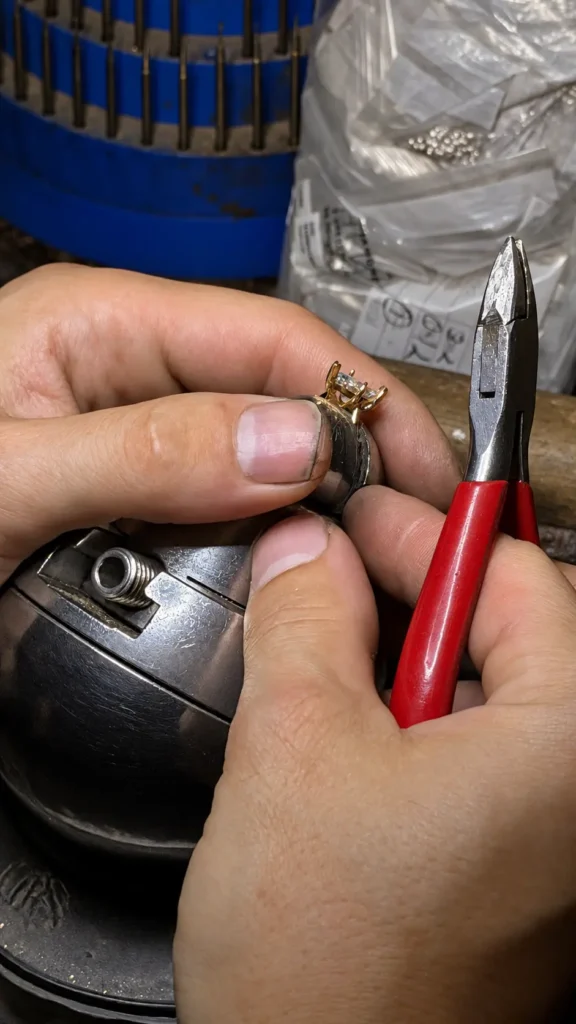
Stone setting choices affect the jewellery manufacturing route from the beginning of design. The setting is not simply a final decorative option added to a finished mount. It influences the surrounding geometry, access for the setter and the sequence in which components can be prepared and assembled.
When choosing a setting style, discuss the actual stone and intended use of the piece alongside its appearance. The right questions are specific to the material, dimensions and construction.
Discuss stone setting manufacturing choices
Discuss the intended setting with the actual stone and mount information.
Bring the setter into the design discussion
The designer can establish the visual intention, while the setter assesses how the stone will be accommodated and secured in the proposed construction. Resolve questions about access and available material before the model is treated as ready for production.
GIA’s setting benchmarks provide examples of assessing workmanship at particular features. They support a feature-based discussion rather than an assumption that the name of the setting alone establishes quality.
Match the design to the actual stones
Provide dimensions, outline, orientation and known condition information. A generic stone representation can help explain a concept but should not conceal missing data about the stones intended for the job.
Material and treatment information can also matter to the workshop route. GIA’s gemstone durability discussion explains why setting, repair and cleaning decisions need to consider the gemstone involved. Disclose known information before the piece reaches those stages.
Consider preparation and assembly access
Some areas may need attention before a stone or adjacent component restricts access. Ask which surfaces should be prepared early and which features must remain for the setter to work. The sequence should be agreed between the relevant operations.
Do not request a fully finished appearance on a mount without confirming what setting preparation remains. Work carried out at the wrong point can need repeating or can alter material that the next operation requires.
Before the next production step
Agree preparation and setting access while the construction can still be reviewed.
Specify the visible result
Describe how the setting should relate to the rest of the design. For repeated or paired pieces, identify the features that should match. A general request for neat setting leaves important visual expectations unspoken.
Use an approved sample where it helps define the result, while keeping any dimensional or technical requirements in the written record. The sample should represent the intended stone and construction closely enough for the decision it supports.
Include setting in production approval
Decide whether first-off approval happens before setting, after setting or at more than one stage. A mount sample can establish some construction features without demonstrating the finished stone arrangement.
Discuss the A&M setting scope with the complete production brief. Confirm how supplied stones are identified, what the workshop assesses and how any unsuitable stone or mount is reported before work continues.
Choose the setting as part of the whole piece
A considered setting decision aligns design, stone data, construction and finishing. Resolve those relationships early so the setter receives a suitable mount and the final inspection compares the result with a clear standard.
Plan the work with A&M
A&M can assess your trade enquiry in the context of the actual piece and requested workshop stages. Bring the references discussed in this guide so the next decision can be made on clear information.
Frequently asked questions
Is one setting style always more secure than another?
Do not treat the style name as a guarantee. Design, material, stone fit, workmanship and condition all need assessment for the actual piece.
Should the mount be polished before setting?
The appropriate preparation and finishing sequence depends on access and construction. Agree it with the workshop, including which surfaces are worked before and after the stones are set.
Can I change the setting style after the mount is made?
Ask for a job-specific assessment. A different setting can require changes to the geometry or new components, so feasibility, cost and timing should be confirmed before proceeding.