
Commissioning & Production Planning
How Jewellery Is Manufactured: From Design Approval to Final Inspection
A finished piece of jewellery brings together design decisions and workshop operations that need to agree with one another. A model can describe an attractive ring while leaving questions about stone fit, assembly access or surface finishing unresolved. Understanding the jewellery manufacturing process helps a brand or retailer decide when those questions must be answered and who should answer them.
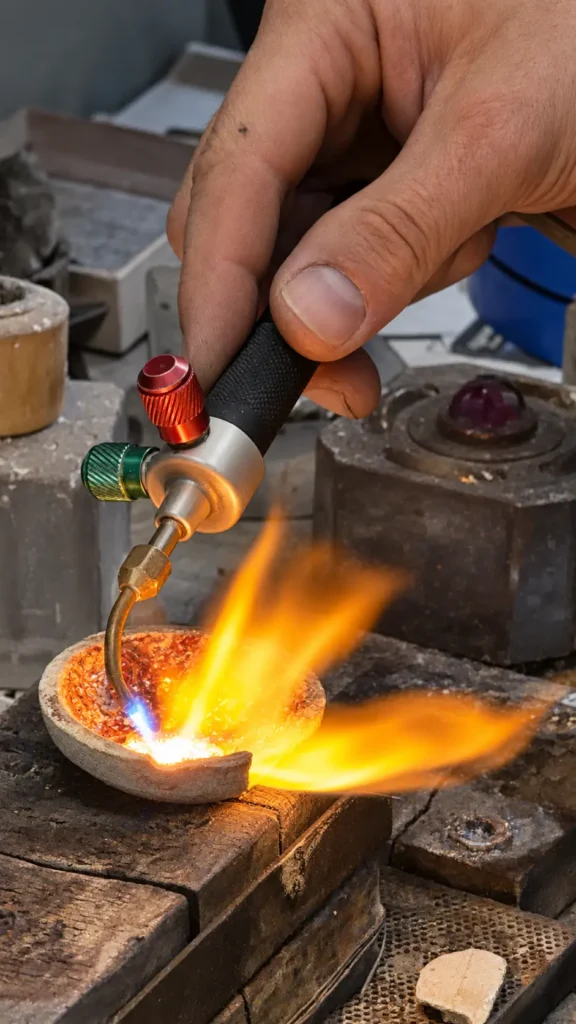
A finished piece of jewellery brings together design decisions and workshop operations that need to agree with one another. A model can describe an attractive ring while leaving questions about stone fit, assembly access or surface finishing unresolved. Understanding the jewellery manufacturing process helps a brand or retailer decide when those questions must be answered and who should answer them.
There is no single route for every piece. A fabricated pendant, a cast ring and a bracelet assembled from supplied components can involve different stages. The useful starting point is the required finished result and a sequence that can actually deliver it.
Discuss jewellery manufacturing process
Map the stages your piece needs, from approved design to final handover.
Design approval establishes the reference
Approve the dimensions, construction, material and stone layout together. An attractive render records appearance; a production drawing or model must also communicate the geometry that controls manufacture. Identify the approved file revision and retain it with the job reference.
Separate approval of the overall design from approval to manufacture. If stone measurements or a joining detail remain unresolved, record that condition. Otherwise, a visual sign-off can be mistaken for permission to proceed with assumptions that the client never considered.
Components need an incoming check
The next stage may involve making components, receiving castings or preparing parts supplied by another workshop. Confirm counts, identification, material information and the condition of the surfaces that will be worked. A supplied mount still needs assessment against the intended stone and construction.
Treat a discrepancy as a decision point. A component that requires correction may change the cost or sequence. A&M describes this assessment within its manufacturing and production support, including review of incoming components before repeat work.
Assembly and setting depend on access
Decide which surfaces need preparation before parts are joined. The underside of a setting or an internal recess may become harder to reach later. Assembly should preserve the alignment and clearances agreed in the design, rather than leave them for the polisher to disguise.
Stone setting brings its own inspection points. The actual stones, their condition and the prepared mounts should be considered together. GIA publishes setting benchmarks that illustrate why workmanship needs to be judged at the setting itself, not simply by the appearance of the whole ring.
Before the next production step
Resolve the next production decision before committing the wider job.
Finishing is a planned stage
Define the required surface finish and where it applies. High polish on the outside does not automatically specify the underside, recesses or contrasting areas. Engraving, plating and hallmarking may introduce additional dependencies that should be agreed before the piece reaches final finishing.
Allow time to inspect a clean piece after the relevant operations. Polishing compound or temporary protective material can obscure a defect. The required cleaning method must suit the materials and stones present, rather than follow one routine for every job.
Final inspection closes the production record
Compare the finished item with the approved reference. Check the agreed measurements, component identity, setting, operation and finish. For a batch, record accepted pieces separately from any held for further work. A first approved sample is a reference for subsequent production, not evidence that every later piece has passed.
The handover should explain what is complete, what was approved during production and whether anything remains outstanding. This gives the retailer a usable record instead of leaving important details scattered across messages.
Make each handover a clear decision
A reliable production route connects design approval to physical checks at the points where mistakes can still be corrected sensibly. Before commissioning the next piece, ask the workshop to describe the stages, required inputs and approval points for that particular construction.
Plan the work with A&M
A&M can assess your trade enquiry in the context of the actual piece and requested workshop stages. Bring the references discussed in this guide so the next decision can be made on clear information.
Frequently asked questions
Does every piece need CAD?
No. CAD is one way to communicate and develop a design. A dimensioned drawing, approved physical reference or established component specification may be suitable, depending on the piece and the workshop route.
Does casting produce a finished ring?
A casting is generally an intermediate component. Its preparation, assembly, setting and finishing requirements depend on the design and on what has been supplied. Confirm the precise starting and finishing condition in the quotation.
When should the client approve the first sample?
Agree this before the batch starts. The approval stage should show the features that matter, such as fit, construction or finish, and should identify any later operations that the sample does not yet represent.