
Stone Setting & Gemstone Care
A Ring Catching on Clothing: How to Brief a Claw Assessment
A ring catching on clothing can prompt a request to smooth the claws.
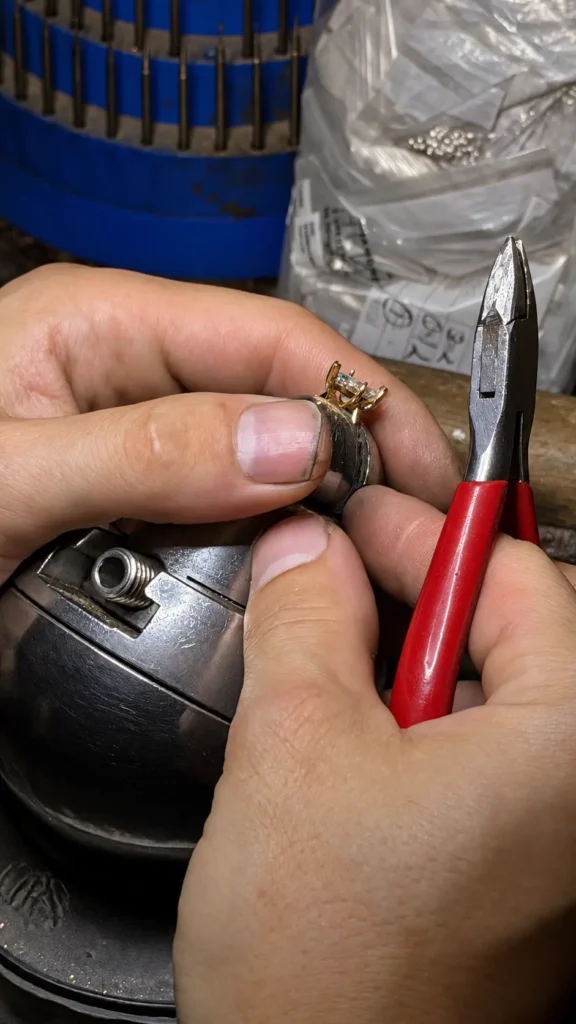
A ring catching on clothing can prompt a request to smooth the claws. That may not be the complete repair question. The catching point could involve a lifted tip, worn metal, a damaged setting or an intentional profile whose condition needs checking.
For a retailer, the useful first step is to describe the behaviour without diagnosing it. Ask the customer when the catching began and identify the location while keeping the piece in its received condition.
Discuss a trade workshop job
Planning claw repair work? Apply for a trade account or call the workshop to discuss the brief.
Record the point of contact
Take clear overall and close views, and describe which side or claw appears involved. Note any recent impact, repair or change in the stone's position reported by the customer. Keep reported history separate from what staff can actually observe.
Do not repeatedly drag the ring through fabric to reproduce the fault. This is a workshop assessment, not a durability test performed at the counter.
Ask for security and metal condition checks
The workshop should consider the stone and its surrounding support, not only the sharp sensation at the tip. Removing metal to make a point feel smoother may be unsuitable if the claw is already thin or the setting requires repair.
GIA's prong-setting benchmark illustrates that contact and the fit of the bearing matter to setting workmanship. Its example is specific; it should not be converted into a universal instruction for every claw design.
Confirm the scope before work starts
Supply the relevant photographs, measurements and known material details. Ask the workshop to assess the proposed work.
Preserve the intended profile where feasible
Supply a clear image of the approved appearance if the claws were deliberately shaped. Explain whether preserving that shape is important, while allowing the workshop to assess what the remaining metal can support.
Retipping, rebuilding, tightening and reshaping are different operations. Ask for the proposed scope to be named, with any visible change explained before the client approves it.
Check the result against the repair scope
At return, confirm the completed work and any remaining condition advice. Review the whole setting and compare the appearance with the agreed result. A smooth-feeling tip alone is not evidence that every structural concern has been resolved.
The setting and claw assessment guide helps retailers distinguish these scopes when explaining the estimate. Keep the customer conversation specific to this ring and the work that was approved.
Treat catching as a useful symptom
A precise description helps the workshop investigate without being restricted to an assumed remedy. Agree the repair after assessment, then retain the findings for any later enquiry about the same setting.
Bring a clear brief to the workshop
For trade enquiries, apply for an account or call A&M to discuss the next step.
Frequently asked questions
Does catching mean the stone is loose?
It does not establish that on its own. The setting needs inspection, and a retailer should avoid assuring the customer that it is secure solely from appearance.
Can staff file the catching claw smooth?
Refer it for appropriate workshop assessment. Removing metal before the condition is understood can change the repair options and erase evidence of the original issue.
Related reading
- How setting and claw work is assessed
- V-Claws and Pointed Stones: What the Setting Brief Should Specify
- A Chipped Diamond Before Resetting: What Must Be Decided?
For service details, see claw repair at A&M.