
Stone Setting & Gemstone Care
V-Claws and Pointed Stones: What the Setting Brief Should Specify
The point of a pear-shaped stone or the corners of a princess cut deserve explicit attention in a setting brief. A retailer may request V-claws for their appearance or protective role, but the term does not describe the complete construction. The actual stone, its condition and the mount around it still determine the assessment.
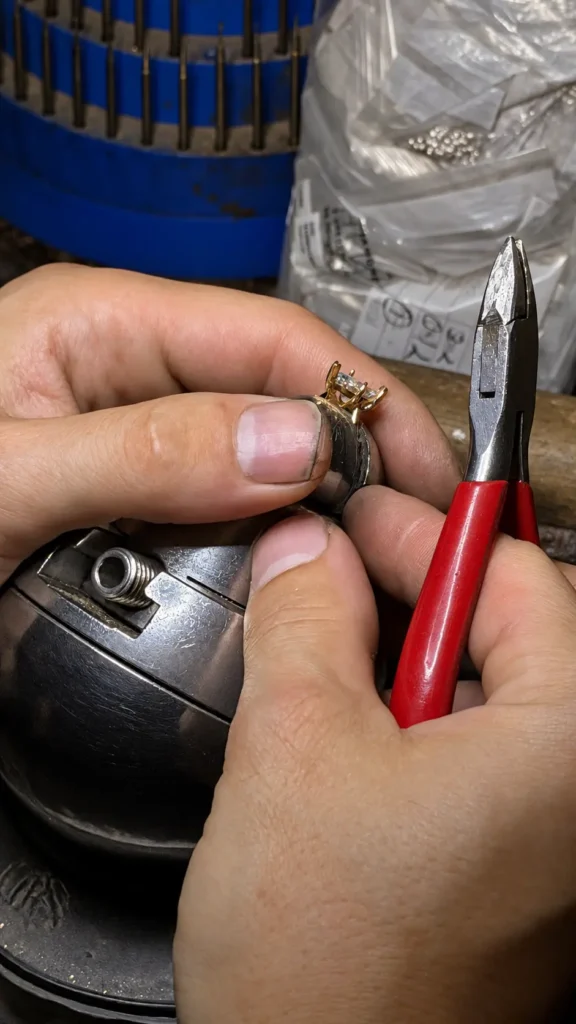
The point of a pear-shaped stone or the corners of a princess cut deserve explicit attention in a setting brief. A retailer may request V-claws for their appearance or protective role, but the term does not describe the complete construction. The actual stone, its condition and the mount around it still determine the assessment.
A&M’s stone-setting page identifies V-claws among the profiles considered for pointed ends. The practical task is to connect that choice to the stone and design, rather than treat it as a component that can be added to any mount without further review.
Discuss v claws for pointed gemstones
Provide the actual stone dimensions and clear views of each pointed corner before selecting the claw profile.
Inspect the corners before designing around them
Record the stone’s dimensions and any known chip, abrasion or other condition concern at the points. Provide a report or previous condition record where available, while recognising that the physical stone remains the reference for setting assessment.
GIA distinguishes diamond hardness from resistance to chipping. A pointed shape should therefore not be described as immune to damage simply because it is a diamond. The setting discussion needs to account for the actual corner condition and the intended support.
Define the intended orientation
Show which way the stone should face in the finished item. A pear point, a marquise end or a princess-cut corner can become an important visual reference within the design. Mark the orientation clearly on a drawing or stone map so it is not left to interpretation at the bench.
If a replacement stone is being used, confirm that its outline and depth suit the existing mount. The stone-dimensions guide explains why equal weight does not establish an equal fit. Changing the stone can require a new assessment of the setting relationship.
Review the mount beneath the claw
The visible tip of a claw is only one part of the structure. Ask whether the supporting metal, seat and neighbouring construction are suitable for the proposed stone. A decorative shape at the top cannot compensate for an unsuitable or worn foundation.
GIA’s princess-cut V-prong benchmark presents different setting constructions and notes that one benchmark does not fit every situation. That is a useful reason to discuss the actual mount, rather than request a copied claw silhouette from a photograph of an unrelated ring.
Before you approve the work
Approve the relationship between the point, seat and supporting mount rather than the claw name alone.
Balance appearance with the assessed construction
Agree how prominent the claws should appear and which details the customer considers important. Reference photographs can explain the desired look, but they should be assessed against the actual stone and available metal. Avoid specifying an extremely fine visible profile without discussing the supporting structure.
For repair work, distinguish tightening, local rebuilding and a more substantial setting change. If the original claw shape cannot be retained as requested, ask for the proposed alternative to be explained before approval. The customer should understand both the cosmetic and functional purpose of the work.
Inspect the finished setting in context
Review orientation, symmetry and the agreed claw appearance alongside the workshop’s setting checks. Keep any pre-existing corner condition in the record so it is not confused with a new observation at collection. Do not promise that a particular profile eliminates the need for care or future inspection.
A good V-claw brief starts with the point it is intended to protect and the structure that supports it. Naming the profile is useful, but the complete stone-and-mount relationship is what turns that preference into a workable setting instruction.
Plan the next step with A&M
Provide the actual pointed stone and proposed claw arrangement so the setting brief can be checked as a complete construction.
Frequently asked questions
Do V-claws guarantee that a pointed stone cannot chip?
No. A claw profile is not a guarantee against impact or damage. Stone condition, supporting construction and appropriate use still matter.
Can a round-stone mount be adapted for any pointed stone?
Do not assume so. The stone’s actual outline, depth and corner positions must be assessed against the mount before an adaptation is proposed.
Should a chipped corner be disclosed before setting?
Yes. Supply any known condition information and allow the workshop to assess it before the setting design or repair route is approved.