
Finishing & Quality Control
When Should Engraving Happen During Jewellery Production?
The right point for engraving during jewellery production depends on access, construction and the intended finished surface. Engraving is not automatically the last operation, and it should not be added to a production plan without considering the stages around it. The workshop needs the final artwork and a clear location before it can assess the route.
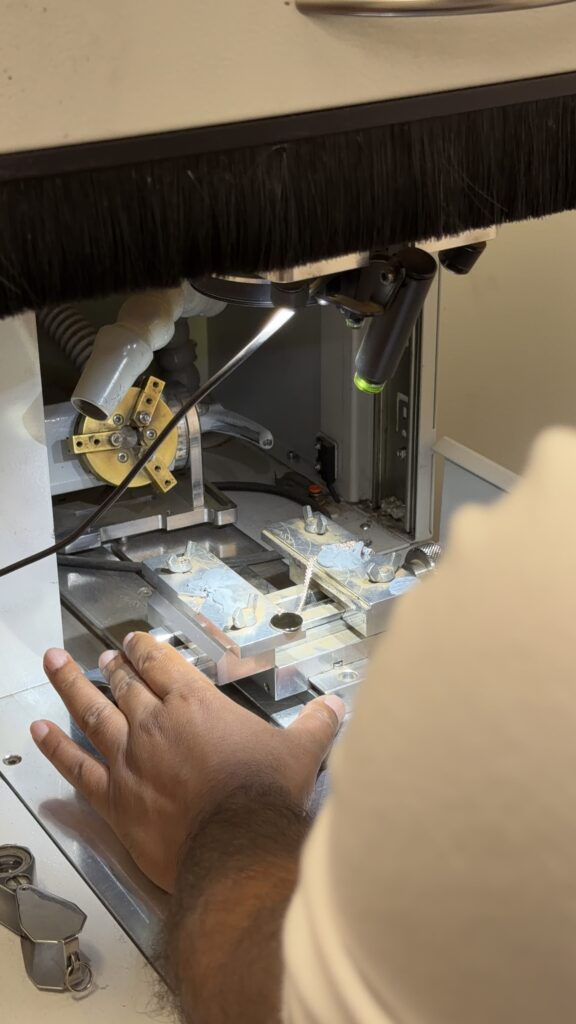
The right point for engraving during jewellery production depends on access, construction and the intended finished surface. Engraving is not automatically the last operation, and it should not be added to a production plan without considering the stages around it. The workshop needs the final artwork and a clear location before it can assess the route.
Raise engraving while the design is still being planned. This gives the team time to resolve space, orientation and the relationship with other marks before the piece is treated as finished.
Discuss engraving jewellery production sequence
Supply the approved engraving content, location and current production stage.
Approve the exact content
Supply the final wording or artwork and identify the version approved for the job. Spelling, punctuation and orientation should be checked by the authorised client. A previous message containing a different version should not remain an ambiguous alternative.
For a batch with individual inscriptions, keep each text tied to the correct item reference. The production record needs to prevent a correct inscription being applied to the wrong piece.
Confirm location and available space
Mark the intended area on a drawing or photograph and discuss the actual surface with the workshop. Curvature, existing detail and nearby components can affect what is practical. Do not rely on a flat artwork preview to establish the finished appearance on every shape.
Agree any size or position requirement through the job assessment. Universal minimum dimensions are not supplied here because the appropriate result depends on the method, material and design.
Consider assembly and setting access
Ask whether the location remains accessible after other components or stones are installed. If not, engraving may need to occur earlier, with suitable protection during later work. The route should be agreed across the relevant stages.
A&M’s engraving and detail service should be discussed with the complete construction and finishing brief. Identify what will already be assembled when the piece reaches that operation.
Before the next production step
Confirm access and finishing sequence before applying the engraving.
Coordinate with the surface finish
Confirm how polishing, texture or plating relates to the engraved area. The intended result should survive the later sequence without an assumption that every mark can simply be refreshed at the end.
If the piece has contrasting finishes, include the engraving in the finish map. A sample may be useful to establish the visual relationship, especially where the lettering or detail is an important part of the product identity.
Keep hallmarking requirements separate
Engraving and hallmarking serve different purposes. Consult the appropriate official hallmarking guidance for precious metal marking requirements, and identify who arranges that stage.
Plan space and access for both where relevant. Do not use decorative lettering as a substitute for a required hallmark or assume that the chosen engraving location leaves suitable space for other agreed marks.
Verify before the final handover
Check the inscription against the approved content, item identity, orientation and location. For personalised batches, reconciliation is as important as surface appearance. Record any piece held for correction separately from completed goods.
The best sequence is the one agreed for the actual construction and finish. Establish it early, then keep the approved artwork and item references intact through production.
Plan the work with A&M
A&M can assess your trade enquiry in the context of the actual piece and requested workshop stages. Bring the references discussed in this guide so the next decision can be made on clear information.
Frequently asked questions
Should engraving always happen after polishing?
Not as a universal rule. The sequence depends on the location, method and intended surface. Agree the route with the workshop before either stage is treated as final.
Can I send engraving text later?
Ask when the final approved content is needed for the planned route. A late change can affect access, scheduling or work already completed, so do not assume it has no production impact.
How should different inscriptions in one batch be supplied?
Use a clear item-to-text record with approved wording for each piece. Confirm the mapping before engraving and reconcile it again at final inspection.