
Commissioning & Production Planning
Bespoke Jewellery Manufacturing vs Batch Production: What Changes?
Bespoke jewellery manufacturing and batch production can involve similar bench skills, but they place different demands on decision making. A bespoke piece needs a result tailored to a particular commission. A batch also needs a way to reproduce the approved result across multiple items.
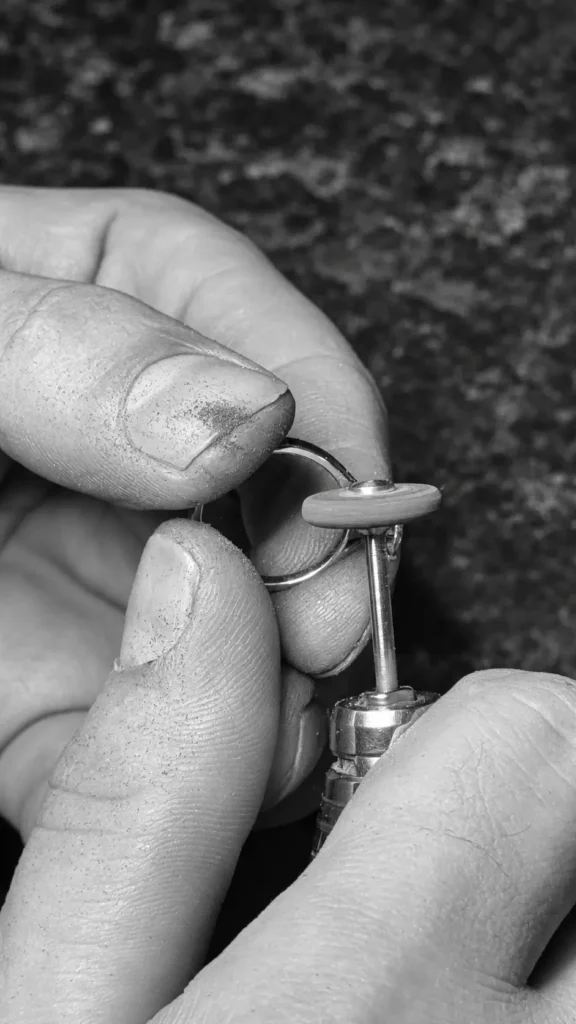
Bespoke jewellery manufacturing and batch production can involve similar bench skills, but they place different demands on decision making. A bespoke piece needs a result tailored to a particular commission. A batch also needs a way to reproduce the approved result across multiple items.
The distinction is not simply one piece versus many. A series of individual commissions can contain more variation than a larger run of a single established design. Understanding that difference helps you brief, approve and price the work sensibly.
Discuss bespoke vs batch jewellery production
Identify which pieces share a standard and which need individual development.
Bespoke work resolves the individual design
A one-off commission may begin with a particular stone, a personal requirement or an existing piece that must be matched. Decisions can develop as the workshop assesses the materials. Record each change so the final instruction remains clear.
The client may place special importance on one feature, such as a setting height or the relationship between two rings. Identify that feature explicitly. It should not be lost among general style references or assumed to follow from the render.
Batch work needs a repeatable standard
For a batch, the approved design must become a practical reference for repeated operations. Define the component specification, stone requirements and finish criteria that each piece must meet. An approved first piece helps establish the standard but does not eliminate variation in later inputs.
If supplied castings or stones differ, the workshop may need to separate them or adjust the route. A batch should therefore include a procedure for exceptions as well as a description of the ideal piece.
Approval means different things
In bespoke work, approval usually authorises the next stage for that commission. In repeat production, it may release a wider quantity. State how many pieces the approval covers and whether it applies to every variant.
A sample in one metal or size should not silently authorise a materially different version. The workshop and client should decide what further assessment is needed. GIA’s workmanship benchmarks support evaluating specific features rather than relying on a general impression of quality.
Before the next production step
Set the approval boundary for the individual pieces and repeated variants.
Pricing follows the work involved
Bespoke pricing can include investigation and development specific to the item. Batch pricing may spread some preparation across repeated work, but inspection and handling still remain. Mixed specifications can reduce the amount of work that is genuinely repeatable.
Review A&M’s trade pricing explanation alongside the actual scope. Consistent volume may be considered for preferential pricing, but quantity alone does not establish the rate or remove the need for an agreed specification.
Inspection must suit the order
For a one-off piece, compare the finished result with the commission’s particular requirements. For a batch, also compare pieces with the approved reference and with one another where matching matters. Keep rejected or held pieces out of the accepted count.
The records should support the next action. A bespoke file may document an individual handover; a production file should also make a future reorder understandable without reconstructing the entire development conversation.
Choose the approach by the degree of variation
Describe the order in terms of common features and individual differences. That gives the workshop a better basis for planning than simply calling it bespoke or bulk, and makes approval responsibilities easier to agree.
Plan the work with A&M
A&M can assess your trade enquiry in the context of the actual piece and requested workshop stages. Bring the references discussed in this guide so the next decision can be made on clear information.
Frequently asked questions
Can bespoke designs become a batch range?
Yes, if the design is reviewed for repeat production and the necessary references are established. A successful one-off piece is a useful starting point, but it does not by itself define the complete batch specification.
Is batch production lower quality?
Quantity does not determine quality. The specification, input consistency, workmanship and inspection arrangements matter. Ask how the required result will be maintained across the proposed run.
Can one order mix bespoke and repeated pieces?
It can be assessed that way, but separate the specifications and quantities. Make clear which items share an approved standard and which require individual decisions or additional development.