
Finishing & Quality Control
Visible Joins in Jewellery: Agreeing the Finish Before Assembly
Visible jewellery joins need an agreed standard, especially on broad reflective surfaces or mixed-metal work.
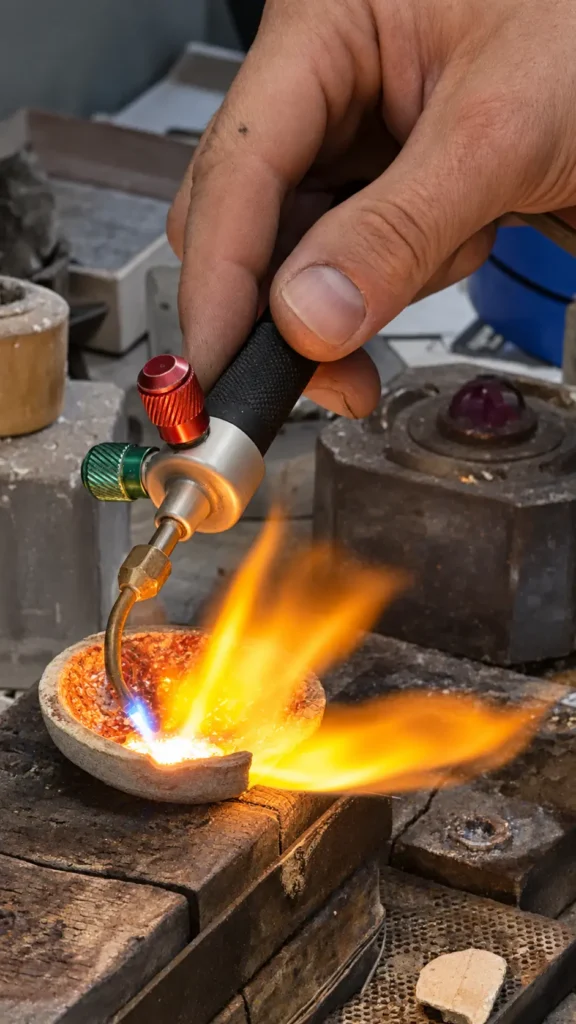
Visible jewellery joins need an agreed standard, especially on broad reflective surfaces or mixed-metal work. A client may mean that the contour should feel continuous, that the colour should match, or that no line should be visible under a particular inspection. Those are different expectations.
Describe the required appearance before the pieces are joined. The workshop can then assess materials, fit and finishing scope instead of being asked to remove an undefined line after completion.
Discuss a trade workshop job
Planning manufacturing and production work? Apply for a trade account or call the workshop to discuss the brief.
Locate the join in the design
Mark its position on the drawing and show the views from which it will be seen. A join on the underside of a pendant may have a different visual role from one crossing the face of a polished bangle.
Identify whether the boundary is intended to disappear or remain as part of the design. Mixed-metal construction can include a deliberate junction that should not be polished away in pursuit of uniform colour.
Separate contour from colour
Ask the workshop to discuss the fit of the components and the expected surface transition. A smooth contour does not necessarily establish an identical colour across different materials or previous repairs.
Provide known alloy and repair information. Where composition is uncertain, record that limitation rather than promising an invisible result based on a photograph.
Confirm the scope before work starts
Supply the relevant photographs, measurements and known material details. Ask the workshop to assess the proposed work.
Agree what finishing may change
Define the edges, engraving and dimensions that must be preserved while the joint is finished. Removing more surface material is not an unlimited way to improve a line. The surrounding geometry sets constraints on the work.
The surface preparation guide explains why correction and final polishing should be treated separately. Ask for any additional corrective work to be identified in the scope.
Review under a defined comparison
Use suitable, consistent lighting and the agreed sample or drawing when assessing the result. Distinguish a normal viewing requirement from a close technical inspection. Avoid changing the acceptance standard only after the work has been completed.
If a visible difference is accepted, describe its location and extent. That decision applies to the identified piece or batch; it should not become an unspoken standard for every future order.
Set a checkable expectation
An agreed location, contour and finish reference gives both parties a practical basis for approval. It is more useful than an unconditional promise that every join will be invisible.
Bring a clear brief to the workshop
For trade enquiries, apply for an account or call A&M to discuss the next step.
Frequently asked questions
Does a visible line prove a weak join?
Appearance alone does not establish structural condition. Ask the workshop to assess the join and explain the relevant findings.
Can polishing remove every join line?
That should not be assumed. Materials, construction and remaining metal can limit the achievable result.
Related reading
- Mixed Metal Jewellery: Planning Construction and Finishing
- Ring Head and Shank Alignment: Checks Before Assembly
- Jewellery Surface Preparation: What Happens Before Final Polishing?
For service details, see manufacturing and production at A&M.