
CAD & Prototyping
Designing Jewellery for Cleaning Access: Questions Before Assembly
Jewellery design cleaning access is easiest to discuss while the construction is still being developed.
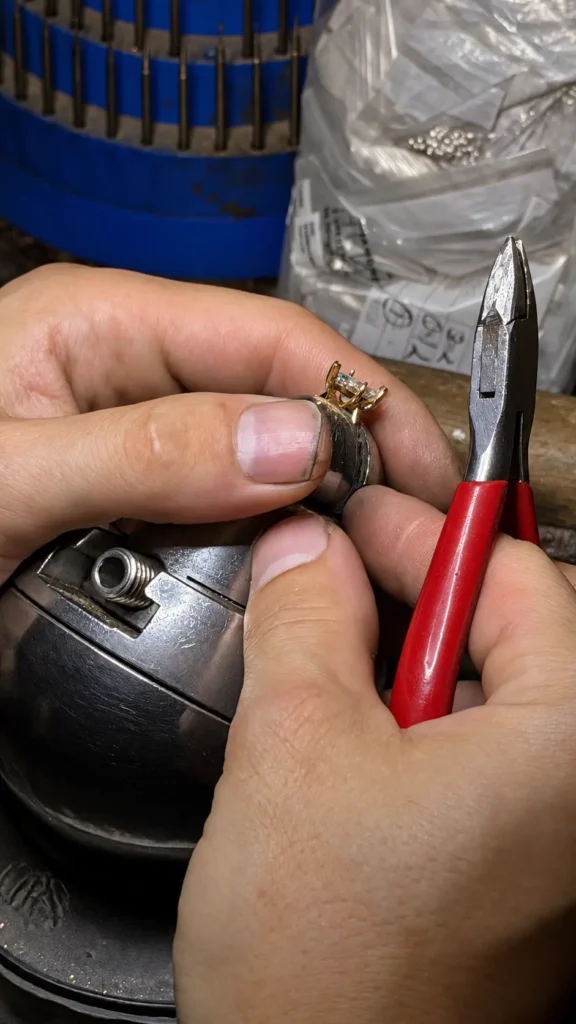
Jewellery design cleaning access is easiest to discuss while the construction is still being developed. Deep recesses, closely packed settings and enclosed details can create surfaces that are difficult to inspect or reach once the piece is assembled.
The aim is not to open every surface or sacrifice the design. It is to understand how the complete piece will be maintained and to make the care instructions consistent with its materials and construction.
Discuss a trade workshop job
Planning CAD and 3D scanning work? Apply for a trade account or call the workshop to discuss the brief.
Identify the surfaces that become enclosed
Use side and section views to locate cavities and narrow passages. Distinguish a decorative recess from an area intended to remain open for access. Ask how the workshop will address the relevant surfaces before and after assembly.
A hole shown in CAD does not prove that a practical tool or cleaning route can use it. Discuss the actual geometry rather than assuming visibility on screen equals access at the bench.
Review the complete material combination
List stones, coatings, adhesives or other components that may affect cleaning. Guidance suitable for one part may be unsuitable for the assembly. The assessment needs to consider everything present, including components hidden from the front view.
GIA's jewellery care guidance explains that cleaning choices depend on materials and treatments. Use that principle to ask the right questions rather than prescribing one machine or solution for the entire collection.
Confirm the scope before work starts
Supply the relevant photographs, measurements and known material details. Ask the workshop to assess the proposed work.
Coordinate access with production sequence
Some surfaces can be prepared before setting or joining but become difficult to reach afterwards. Identify those stages and the required handover condition. The pre-polishing guide discusses a related access decision.
Do not assume that a surface left inaccessible can simply be corrected after final assembly. If the design depends on a particular internal finish, establish how it will be achieved and checked.
Write care instructions from the approved product
The final instructions should reflect the actual stones, finish and construction. Avoid a generic instruction to use ultrasonic cleaning merely because another product in the range permits it. Where professional assessment is required, make that boundary clear.
Keep the product record available for later service so the workshop is not forced to infer hidden construction from the finished piece alone.
Make maintenance a design consideration
A short access review before approval can expose questions that would otherwise arise only after sale. Resolve them with the workshop and keep the resulting care guidance tied to the correct product revision.
Bring a clear brief to the workshop
For trade enquiries, apply for an account or call A&M to discuss the next step.
Frequently asked questions
Does an open-back setting guarantee easy cleaning?
No. Access depends on the whole geometry and materials. An opening may help a particular task without making every cleaning method suitable.
Should customers use tools to reach narrow recesses?
Do not invent home-maintenance instructions. Use the care advice appropriate to the finished piece and refer uncertain conditions for professional assessment.
Related reading
- Open-Back and Closed-Back Gemstone Settings: What Changes in the Brief?
- Pre-Polishing Before Stone Setting: When and Why It Matters
- Jewellery Aftercare Cards: Match Instructions to Materials and Treatments
For service details, see CAD and 3D scanning at A&M.