
Jewellery Design Details
Gallery Rails in Engagement Rings: Purpose, Position and Design Approval
A gallery rail is one of the details that can be missed when an engagement ring is approved mainly from above. Its position affects the side view and its relationship to the claws belongs in the construction discussion. The right question is how that feature works within the particular setting, not whether a single rail design should be copied onto every ring.
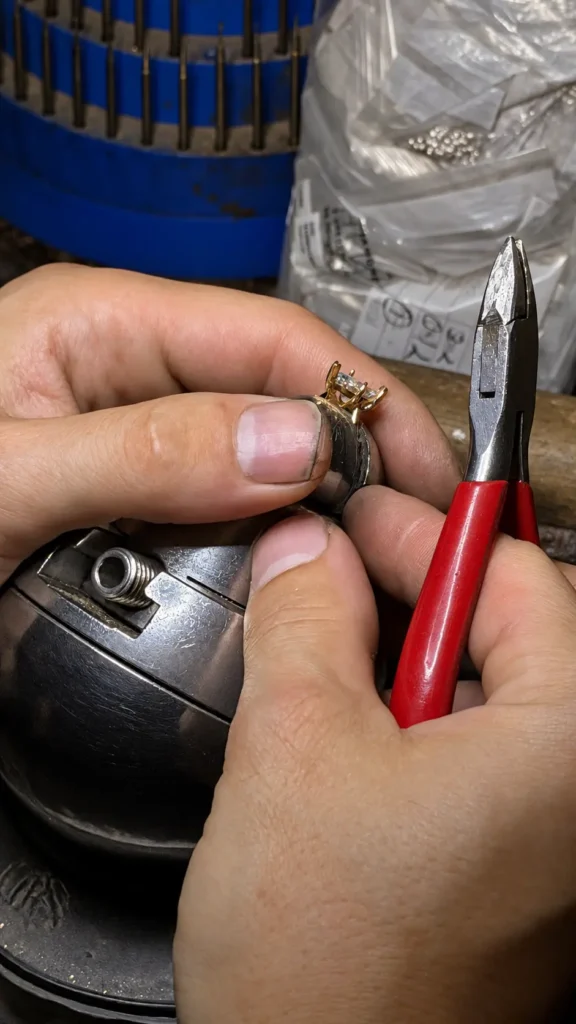
A gallery rail is one of the details that can be missed when an engagement ring is approved mainly from above. Its position affects the side view and its relationship to the claws belongs in the construction discussion. The right question is how that feature works within the particular setting, not whether a single rail design should be copied onto every ring.
Terminology can vary between drawings and sales descriptions. Use an annotated image to identify the component being discussed, especially where a design also contains a bridge, decorative gallery or stones beneath the centre setting.
Discuss engagement ring gallery rail
Supply side and underside views showing the proposed rail, claws and actual centre-stone dimensions.
Understand the feature in context
Casting House’s ring anatomy guide identifies a gallery rail that helps support the prongs in its illustrated construction. That explains the role of the feature in that example. It does not establish that every ring requires the same position, dimensions or design.
Ask the workshop to explain the proposed supporting arrangement for the actual stone and mount. A rail should be considered alongside the claws, seat and surrounding metal. Its presence alone should not be used as proof that the complete setting is secure or suitable.
Review the side appearance early
Show the customer the rail from the angles in which it will normally be seen. Discuss whether it is intended to be discreet, decorative or part of a particular gallery style. A feature approved only in a top view can become unexpectedly prominent in the finished ring.
If reference images are used, separate appearance preferences from technical dimensions. The rail in another ring may surround a stone with different depth or proportions. The manufacture-ready CAD guide explains why the actual production information should govern the model.
Consider the stone and setting access
Ask how the rail relates to the stone’s underside and the space needed for the setting work. The relevant dimensions should come from the actual stone or an agreed reliable specification. A general carat weight is not enough to establish every clearance.
A&M’s stone-setting enquiry considers the stone and mount together. If the design changes after the setter has reviewed it, return the revised construction for confirmation where the change affects support or access. Do not assume that a visually small adjustment is technically irrelevant.
Before you approve the work
Review the rail as part of the complete setting before approving a cosmetic change to it.
Treat removal or addition as a design change
For an existing ring, a request to remove a rail for a cleaner appearance needs assessment before a promise is made. Adding one also requires a suitable proposal for the retained construction. Neither should be described as a purely cosmetic operation without considering the setting.
Record the reason for the proposed change and the appearance the customer wants. If the workshop recommends retaining or revising the feature, ask for the explanation in terms of the actual ring. Avoid universal claims based on a style preference or a single photograph.
Approve the complete setting
The final design record should show the stone, claws, rail and supporting mount together, with the agreed side appearance. Keep revisions controlled so an approved supporting feature is not lost when another part of the model is changed.
A gallery rail is most usefully discussed as one element of a complete construction. Clear views and a stone-specific assessment allow the retailer to explain both its appearance and its intended role without overstating what the feature alone can guarantee.
Plan the next step with A&M
Include the stone, claws and gallery in the design reference so a proposed rail change can be assessed in context.
Frequently asked questions
Does every engagement ring need the same gallery rail?
No. The appropriate supporting construction depends on the actual design, stone and setting. A single example should not be treated as a universal specification.
Can a rail be removed because it is visible from the side?
That needs a workshop assessment. A change to a supporting feature should not be approved solely as a cosmetic preference.
Is a top-view CAD render enough to approve the gallery?
No. Side and underside views are useful for understanding the rail’s appearance, relationships and relevant access.