
Stone Setting & Gemstone Care
Invisible Setting Repairs: Why Specialist Assessment Comes First
An invisible-set piece can conceal the very structure that needs assessment when a stone becomes loose or goes missing. The absence of obvious claws does not make the repair simpler. It means the workshop must understand how the stones and their hidden support were designed to work together.
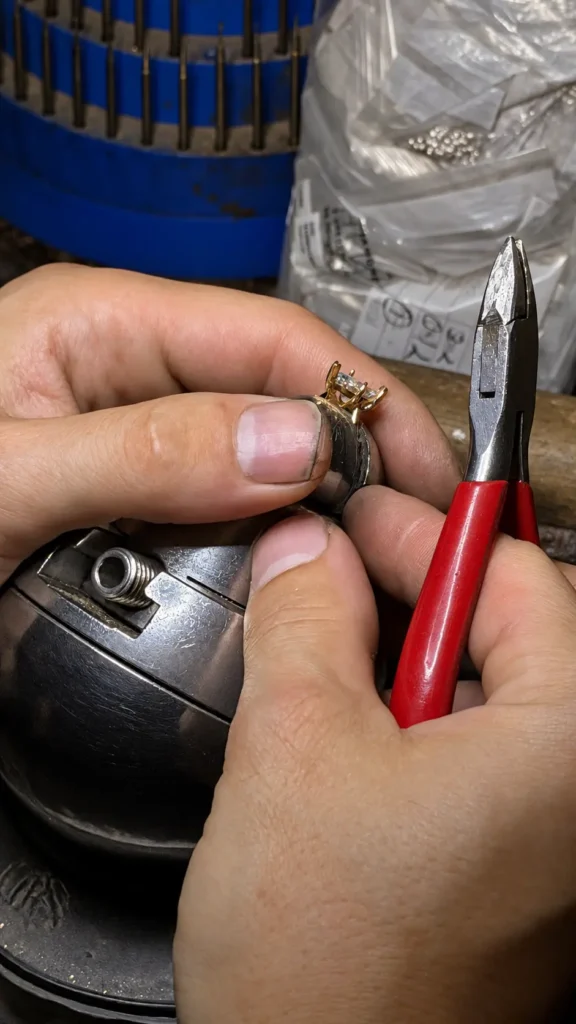
An invisible-set piece can conceal the very structure that needs assessment when a stone becomes loose or goes missing. The absence of obvious claws does not make the repair simpler. It means the workshop must understand how the stones and their hidden support were designed to work together.
The term covers an appearance as well as a construction idea, so a retailer should not assume that every piece uses the same system. Begin with the maker’s information, clear photographs and a request to confirm the appropriate assessment route. Acceptance of the particular design should come before a repair promise.
Discuss invisible setting repair assessment
Provide the maker’s details where known and confirm whether the workshop can accept the particular construction.
Establish the construction and maker
Record any reliable brand, model or original sales information. Where the maker provides an aftercare route for its own work, obtain that information before authorising an independent alteration. This can be especially relevant when components or methods are specific to a particular design.
Van Cleef & Arpels describes its own Mystery Set technique as using specially cut stones arranged on concealed rails. That is a first-party example of a particular system, not a specification for every item described as invisibly set. Do not infer a maker or technique from the surface appearance alone.
Document the affected panel
Photograph the complete piece, the relevant panel and the accessible underside. Identify missing, displaced or visibly damaged stones by position. If a stone has become detached, keep it safely with the item and label it as supplied material rather than trying to push it back into place.
Record whether the panel has been repaired or altered before, where known. The workshop needs to distinguish current observations from assumed construction. A photograph of an empty position may help an initial discussion, but it cannot confirm the condition of hidden support.
Do not buy a replacement on appearance alone
A stone that looks similar from above may not suit the actual setting requirements. Dimensions, shape and any construction-specific preparation need to be established by the appropriate specialist. The stone-dimension guide explains why a general weight or face-up description is insufficient.
Agree who will source or prepare any replacement and how matching will be judged. If the piece contains a continuous field of colour, the customer should understand that a visible match and a technically suitable fit are related but separate requirements.
Before you approve the work
Obtain a construction-specific proposal before buying a replacement stone or promising a repair.
Define the assessment route before the repair scope
Ask whether the item can be assessed locally, needs referral or should be returned through the original maker. A&M’s setting enquiry page is a starting point for describing the stone and mount, but acceptance of an unusual construction must be confirmed for the individual piece.
If a staged examination is proposed, record what that stage authorises and where further approval is required. Do not turn permission to investigate into open-ended permission to alter a panel or replace stones. The customer should understand what remains uncertain at each decision point.
Keep the final record construction-specific
The completed record should identify the affected positions, any replacement stones and the supporting work actually carried out. Avoid generic statements that the whole piece has been renewed unless that accurately describes the authorised scope. Retain any specialist findings with the job.
Invisible setting repairs benefit from precise routing and careful expectations. The retailer’s most valuable early contribution is to preserve the evidence, confirm the construction and ensure that a specialist proposal comes before component purchasing or an assured outcome.
Plan the next step with A&M
Send the available setting information first and confirm whether the proposed specialist assessment can be accepted.
Frequently asked questions
Can any square stone replace a missing invisible-set stone?
No. The appropriate specialist must confirm the dimensions, preparation and matching requirements for the particular construction.
Does invisible setting always mean Mystery Set?
No. Mystery Set is associated with Van Cleef & Arpels’ technique. Do not attribute an unidentified piece to a maker or system from appearance alone.
Should the loose stone be pushed back into position?
No. Preserve it with the item for assessment. An apparently empty space does not establish that the hidden support remains suitable.