
Stone Setting & Gemstone Care
Channel Setting Repairs: Assess the Row, Not Just the Missing Stone
A missing or moving stone in a channel-set ring should prompt a review of the row around it. The empty position is easy to see, but the workshop also needs to assess the supporting metal and the stones that remain. Ordering a replacement by approximate size before that inspection can put the decisions in the wrong order.
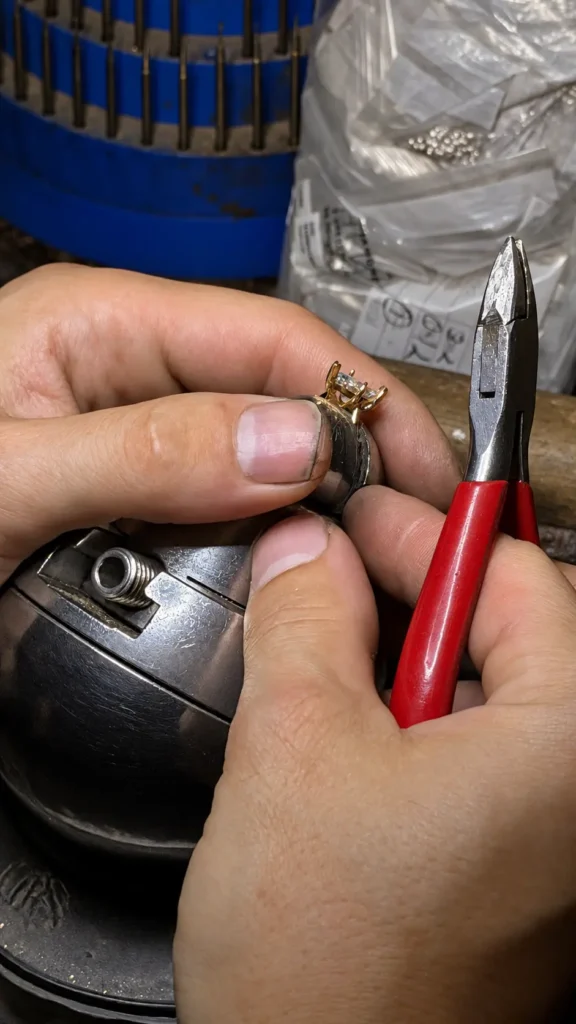
A missing or moving stone in a channel-set ring should prompt a review of the row around it. The empty position is easy to see, but the workshop also needs to assess the supporting metal and the stones that remain. Ordering a replacement by approximate size before that inspection can put the decisions in the wrong order.
GIA describes a channel setting as a row of stones held between parallel metal walls. For a repair enquiry, that construction makes the relationship between stone fit and surrounding support central to the assessment. The customer’s requested outcome and the condition found at the bench should stay distinct.
Discuss channel setting repair
Identify the affected stone position and provide clear views along the complete channel.
Map the affected position
Use an annotated photograph to identify the missing or suspect stone. Show the complete set section from above and at an angle, including the underside where accessible. If more than one stone is affected, number the positions rather than relying on phrases such as the small one near the end.
Retain any detached stone and identify where the customer believes it came from. That account can guide inspection, but the workshop should confirm suitability before it is treated as the correct replacement for a particular seat. Keep the item and loose material under one reference.
Inspect the channel walls and neighbouring stones
Ask whether the channel’s condition supports a local repair or whether a wider section needs attention. Wear, distortion or an earlier alteration may affect more than the visibly empty position. The proposal should describe those findings rather than make a new stone the only deliverable.
The setting and claw assessment guide explains the value of inspecting supporting metal as well as the stone. Although setting constructions differ, the intake principle is useful: describe the whole affected area and avoid assuming that one visible symptom defines the entire job.
Select a replacement against the actual setting
If a stone is required, establish its dimensions, shape and matching requirements after the relevant condition has been assessed. Carat weight alone is not a fit specification. The existing guide to stone dimensions for mount design explains that distinction.
Agree who will source the stone and how a proposed match will be approved. A replacement may need to relate visually to older stones that are already in the ring. Record the customer’s priority and any acceptable difference before the workshop proceeds with setting.
Before you approve the work
Confirm whether the supporting metal needs work before a replacement stone is selected and set.
Define the finished row
Discuss the expected alignment, spacing and surface appearance after repair. A functional correction should be assessed in the context of the whole channel, not only at the repaired point. If the proposal changes the supporting metal visibly, explain that before approval.
A&M’s stone-setting enquiry provides a route for discussing the stone and mount together. Confirm acceptance and scope for the actual construction before arranging work. Any associated metal repair, replacement stones and refinishing should be identified in the same coordinated proposal.
Check the complete set section at return
At handover, compare the repaired row with the approved stone map and scope. Record which stones were supplied, replaced or reset and what supporting work was completed. Keep any agreed limitation attached to the job record rather than relying on a verbal explanation that may be lost later.
Channel setting repair is most clearly managed as a relationship between the row and its support. That approach helps the retailer explain why a replacement stone is sometimes only one part of the work required.
Plan the next step with A&M
Supply the complete channel-set piece and ask for the surrounding row to be assessed alongside the reported concern.
Frequently asked questions
Is a missing channel-set stone always a simple replacement?
No. The channel walls, remaining stones and any distortion need assessment before the replacement and setting scope are confirmed.
Can the replacement be ordered by carat weight?
Weight alone does not define fit. The actual dimensions, shape and visual matching requirements should be agreed for the assessed setting.
Should neighbouring stones be checked?
Yes, the affected set section should be considered as a whole. A local symptom does not establish the condition of the surrounding support.