
Materials & Mount Preparation
Manufacturing Jewellery in 9ct vs 18ct Gold: Practical Considerations
Manufacturing a design in 9ct and 18ct gold involves more than changing the material description on an order. The gold content differs, while the full alloy composition and its condition influence how the material is worked. A useful comparison therefore starts with the specific alloys and the intended construction.
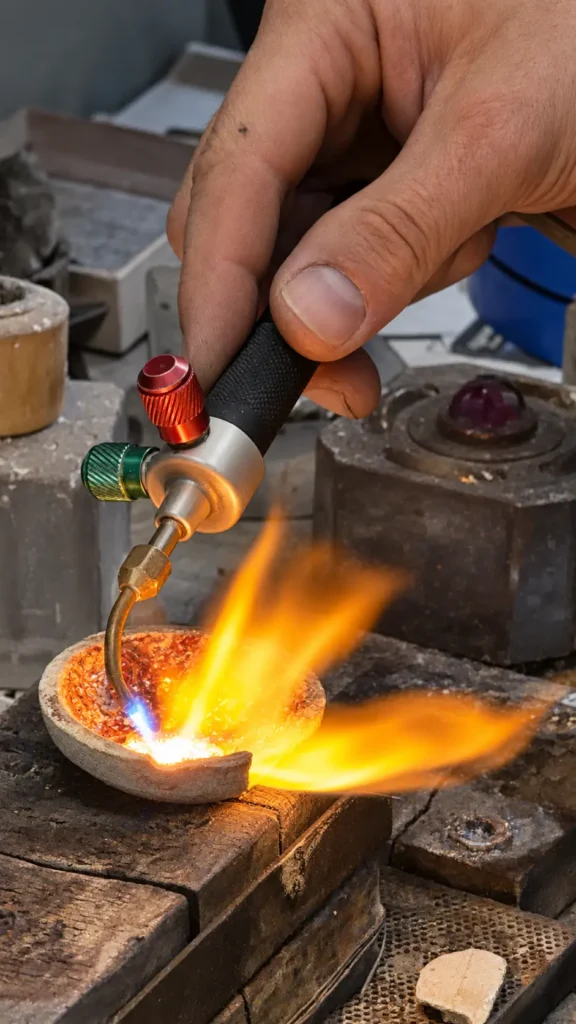
Manufacturing a design in 9ct and 18ct gold involves more than changing the material description on an order. The gold content differs, while the full alloy composition and its condition influence how the material is worked. A useful comparison therefore starts with the specific alloys and the intended construction.
Keep the two versions identifiable throughout development. Even if their dimensions and appearance are intended to match, the manufacturer needs a clear record of which material applies to each piece.
Discuss 9ct vs 18ct gold manufacturing
Provide the proposed 9ct and 18ct specifications for a like-for-like production discussion.
Understand what fineness tells you
Gold fineness describes the proportion of gold in the alloy. The familiar 9ct and 18ct designations correspond to 375 and 750 parts per thousand respectively. Fineness does not by itself describe every other metal present or every working characteristic.
The official hallmarking guidance explains the role of fineness marks. For manufacturing decisions, also obtain the relevant supplier specification rather than relying only on the carat designation.
Avoid broad hardness assumptions
Do not choose a production route on the assumption that every 9ct alloy behaves one way and every 18ct alloy another. Ask the supplier and workshop about the actual formulation and material condition for the job.
This matters when deciding how components will be produced, joined, set and finished. If a material is substituted, record the change and review any operation that depended on the original specification. Similar colour does not establish technical equivalence.
Compare the intended colours physically
Yellow, rose and white gold descriptions can cover different appearances. Where matching is important, compare representative samples with the same finish under consistent lighting. A photograph from a supplier’s catalogue may not be sufficient for a close colour decision.
For white gold, state any rhodium requirement separately. The underlying alloy and the final surface treatment are two parts of the specification. The A&M finishing guide provides related context for discussing the intended surface.
Before the next production step
Compare the actual alloys and finish references before selecting the production route.
Review construction in each version
The model, component specification and setting requirements should be assessed for the actual material. Do not assume a sample in one fineness automatically approves the other version. Ask which checks can be shared and which need separate confirmation.
If the design combines components from several sources, identify the material of each. A clear bill of materials helps avoid a visually similar part being introduced into the wrong variant during assembly.
Compare quotations on the same basis
Keep dimensions, quantity, finish and included operations consistent when comparing the two versions. Confirm how estimated weights and changing material prices are handled. A comparison of metal content alone does not calculate the full manufacturing cost.
A&M’s pricing information should be read alongside the job-specific quotation. Ask for each version to be identified explicitly, including any differences in development, preparation or finishing work.
Approve the actual alloy and result
The practical decision is between defined materials used in an agreed construction. Record fineness, alloy information and the approved appearance, then keep those references with each version for future production.
Plan the work with A&M
A&M can assess your trade enquiry in the context of the actual piece and requested workshop stages. Bring the references discussed in this guide so the next decision can be made on clear information.
Frequently asked questions
Is all 9ct gold harder than all 18ct gold?
Do not use that as a universal manufacturing rule. Working properties depend on the alloy and its condition. Obtain supplier information for the actual material being considered.
Can the same finish be requested on both versions?
You can specify the intended appearance, but assess the result on the actual materials. Matching finish names do not guarantee identical colour or appearance across different alloys.
Does one sample approve both finenesses?
Only to the extent explicitly agreed. Identify what the sample establishes and review any material-dependent production or appearance questions separately before releasing the other version.