
Stone Setting & Product Construction
Tapered Baguette Side Stones: Specifying the Pair Before Mount Design
Tapered baguette side stone measurements describe more than a total carat weight.
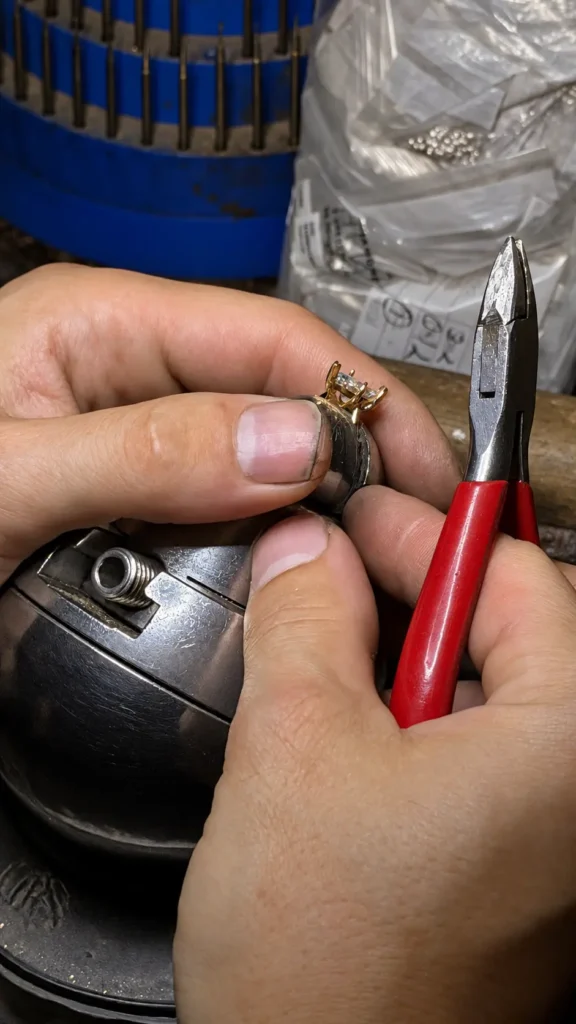
Tapered baguette side stone measurements describe more than a total carat weight. A pair has a directional outline, with a wider and narrower end, and a relationship to the centre stone. The mount must accommodate those actual features rather than a generic tapered shape in a render.
For retailers commissioning a three-stone design, approve the stone pair and the intended arrangement together. A replacement pair with the same combined weight may still change the visible proportions or require a different mount.
Discuss a trade workshop job
Planning stone setting work? Apply for a trade account or call the workshop to discuss the brief.
Identify each stone and each end
Record the length, both end widths and relevant depth information for each stone. Label left and right as viewed from a defined position. Include clear photographs so the workshop can connect the measurements to the correct member of the pair.
Do not assume the narrower ends face inwards. State the intended orientation and show it beside the centre stone. This avoids an apparently minor reversal becoming part of an approved model.
Compare the pair in context
Assess the stones together for outline, visible colour and the appearance required by the design. Then place that comparison in the context of the centre stone. Two side stones may match each other while looking too wide, too long or differently angled for the chosen arrangement.
The calibrated gemstone guide separates dimensional fit from visual matching. Both questions matter here, and neither is answered fully by a combined carat weight.
Confirm the scope before work starts
Supply the relevant photographs, measurements and known material details. Ask the workshop to assess the proposed work.
Resolve the setting relationship
Ask the setter to review the stones and proposed support before finalising the mount. Identify where the visible metal will sit and how the side settings meet the centre head and shoulders. Avoid prescribing a universal seat dimension from a photograph.
Use top and side views to discuss height and angle. A top view can make the arrangement look symmetrical while concealing an unwanted difference in elevation. Record the intended result in the same drawing set.
Treat substitutions as a fresh decision
If one stone becomes unavailable, assess the replacement against the actual counterpart and mount. Do not release it on the strength of a supplier's nominal description alone. Record any resulting change to the pair, setting or appearance before work proceeds.
For repeat designs, distinguish an approved style from a guarantee that every future pair will fit the original geometry. The stone specification and acceptance checks should support the production approach that has been agreed.
Release a defined pair
Keep the pair references with the model and workshop job. The final comparison should confirm orientation and the relationship between all three stones, as well as the individual setting work.
Bring a clear brief to the workshop
For trade enquiries, apply for an account or call A&M to discuss the next step.
Frequently asked questions
Is total carat weight enough to specify the pair?
No. It does not establish the two end widths, depth, orientation or visual relationship between the stones. Supply measurements and clear pair identification.
Can the setting be made before the side stones are selected?
Discuss provisional dimensions with the workshop, but identify what remains conditional. Final fit should be assessed against the stones that will actually be set.
Related reading
- Why Stone Dimensions Matter More Than Carat Weight for Mount Design
- Calibrated Gemstones in Jewellery Production: Checking Consistency
- Engagement Ring Manufacturing: From Approved Design to Finished Mount
For service details, see stone setting at A&M.