
Stone Setting & Gemstone Care
Reusing a Customer’s Diamonds in a New Jewellery Design
A customer’s existing diamonds can give a new design a personal starting point, but the design should develop around the stones that are actually available. Their condition, dimensions and relationship to the original settings need assessment before a retailer promises a particular arrangement or finished appearance.
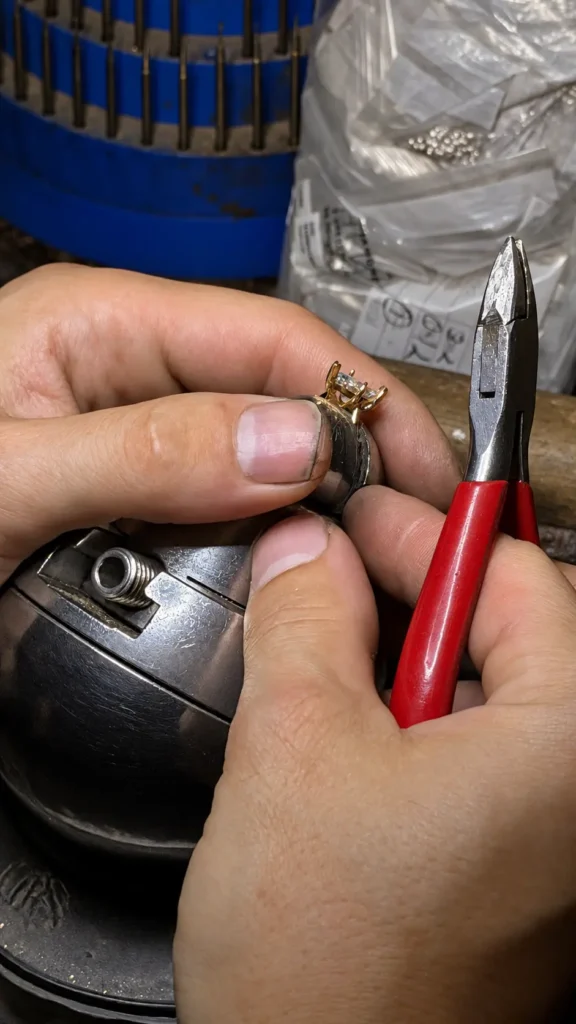
A customer’s existing diamonds can give a new design a personal starting point, but the design should develop around the stones that are actually available. Their condition, dimensions and relationship to the original settings need assessment before a retailer promises a particular arrangement or finished appearance.
The commission also contains two distinct decisions: what may be done to the existing piece and what the new piece should become. Keeping those approvals separate helps prevent a customer’s enthusiasm for a redesign from being treated as permission to dismantle jewellery before the implications are understood.
Discuss reusing diamonds in new jewellery
List the existing pieces and identify which diamonds the customer wants included in the new design.
Identify the stones and their starting condition
Record the supplied items, stone positions and any available reports or previous condition notes. A report number can be useful information, but it should remain connected to the physical stone through the agreed identification process. Do not assume that loose paperwork establishes every detail of an assembled item.
GIA notes that mounted-jewellery assessments are limited by what the setting permits. That distinction is useful when explaining why further observations may be possible after a stone is removed. Record what has been inspected and what remains obscured rather than presenting a complete condition assessment prematurely.
Authorise removal separately
Ask the workshop to explain the proposed dismantling scope and any relevant condition concerns before removal begins. The customer should understand which original parts may change and whether the existing item is intended to remain usable afterwards. Do not describe removal as automatically leaving the old setting intact.
Keep detached components and stones identified under the job reference. The existing guide to client-supplied stone records provides a useful recordkeeping principle, even though a personal redesign is different from a repeat production batch.
Design from actual measurements
Once the relevant stones have been assessed, use their dimensions, outlines and orientation requirements in the new brief. The stone-dimensions guide explains why stated weight is not enough to establish mount fit. A design built around an assumed standard stone may need revision when the actual proportions are considered.
Discuss whether the customer wants all available diamonds used or whether a selected arrangement is acceptable. Different sizes can be a design opportunity, but they should be planned deliberately. Agree any additional stones separately, including who will supply them and how the visual relationship will be approved.
Before you approve the work
Confirm stone condition and dimensions before treating the new mount design as ready for manufacture.
Review the new construction and retained meaning
The CAD and 3D scanning enquiry can help define a new model or adaptation where that is part of the proposed route. Approve the layout, scale and setting relationship together. A render can communicate appearance, while the production specification needs to establish the physical construction.
If a particular diamond carries personal significance, identify it by position in the new design. Do not leave its allocation to an assumption that the largest stone is always the one the customer values most. A simple approved stone map can preserve that intention through manufacture.
Reconcile the completed commission
At handover, compare the finished arrangement with the approved map and account for stones or components not used. Retain the relevant measurements, condition notes and design approval with the job. Avoid unsupported claims about the amount of material saved or the environmental impact of the redesign.
Reusing diamonds works best when their personal value is matched by a precise workshop record. Clear authority for removal, a design based on assessed stones and an agreed final allocation give the customer a more reliable path from old piece to new.
A personal jewellery enquiry?
Exploring a new design using your own stones? Contact Kinzy London about a personal purchase or design enquiry and confirm the available options. A&M’s workshop services are for jewellery businesses.
Frequently asked questions
Can the design be finalised from the original receipt alone?
No. The actual stones and their relevant dimensions and condition should inform the new construction. Paper records are supporting information.
Must every diamond from the old piece be used?
Only if that is the agreed and feasible design objective. Record which stones must be included and how unused material will be handled.
Does approving a sketch authorise dismantling the original jewellery?
That should be made explicit. The removal scope and its implications should be approved separately from the appearance of the new design.